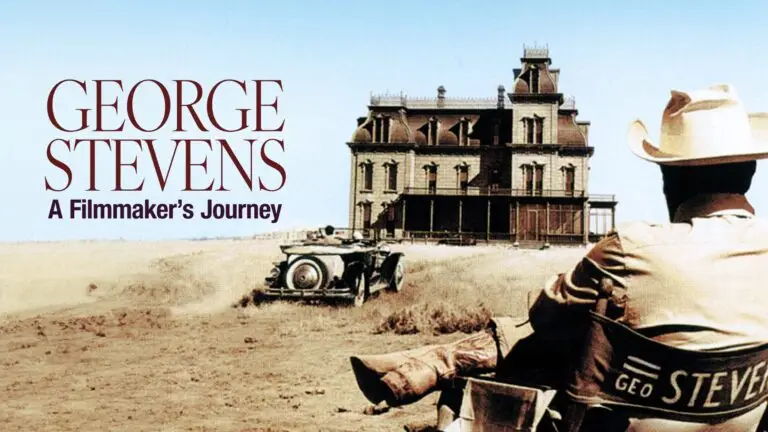
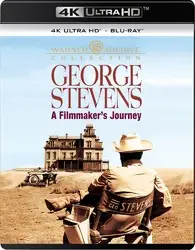
 In a career spanning more than fifty years, George Stevens directed nearly sixty films and took home the Oscar for Best Director twice, in 1951 for A Place in the Sun, and again in 1956, for Giant. In 1985, ten years after his death, George Stevens: A Filmmaker’s Journey was released in the United States. Written, directed, and narrated by George Stevens Jr.., it has long been among my favorite film history documentaries.
Both a tribute to his father, and a career spanning survey of his work, Warner Archive recently released a wonderful 4K edition of the film, funded by Steven Spielberg, Kate Capshaw, Heather Reisman, Gerry Schwartz, Martin Scorsese and The Film Foundation.
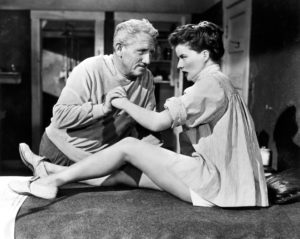
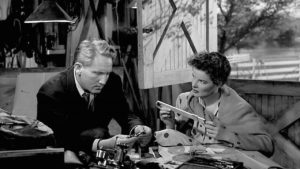
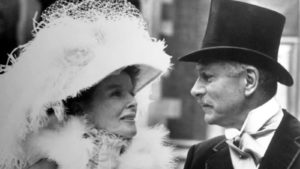
Interviews with such luminaries as Warren Beatty, Frank Capra, Douglas Fairbanks Jr, Cary Grant, Katharine Hepburn, John Huston, Joseph L. Mankiewicz and Millie Perkins, among others, are sprinkled in with the expected clips of Stevens’ films, including 1935’s Alice Adams—Katharine Hepburn engineered Stevens’ break away from second unit work and B features when she agreed to star in it—up through Swing Time (1936), Gunga Din (1939) Woman of the Year (the first pairing of Spencer Tracy and Katharine Hepburn), (1942) A Place in the Sun (1951), Shane (1953), Giant (1956), and The Diary of Anne Frank (1959), and more, proving himself adept at comedy, drama and action, along the way.
Some of the most interesting footage is the rare color film Stevens shot himself while leading a newsreel unit during World War II. His footage of the landing at Normandy, the liberation of Paris, and Dachau Concentration Camp is a fascinating historical record. For all his accomplishments, Stevens comes across as a dedicated and professional filmmaker who cared about people. This is particularly clear in his fiery defense of colleagues during the McCarthy era. The home movies included here, go a long way in humanizing this Hollywood legend.
While Stevens Jr. clearly loves and respects his father, George Stevens: A Filmmaker’s Journey is surprisingly even handed. Of course, the interviewees all have nice things to say about Stevens, but the unevenness of his later work (Despite mostly positive reviews, and a Best Actress Oscar win for Shelley Winters, The Diary of Anne Frank underperformed at the box office as did his next film, 1962’s epic The Greatest Story Ever Told) are discussed. Katherine Hepburn laments Stevens’ shift to more serious fare after he returned from World War II.
While a few of the clips go on too long, George Stevens: A Filmmaker’s Journey is a real feast for film lovers and stands as an impressive document of some of the most pivotal moments in American history. For those whose knowledge of film starts with Spielberg, this film offers an opportunity to hear from other directors and creatives that inspired him to become the director he is today.
Given a new 4K scan with Dolby Vision support, the various film clips and interview clips have never looked better. The color footage really pops, and Elizabeth Taylor’s red lipstick shines! The films’ natural grain structure gives things a film-like look throughout. The black-and-white sequences offer up inky blacks and stable whites. The print is free of any debris or scratches. The included Blu-ray is an equally stunning (though not as vivid), transfer.
The DTS-HD 2.0 Master Audio mix serves this film well, offering clean, clear and concise dialogue throughout. action beats have a nice fullness to them, as does Carl Davis’ delicate score. There are no apparent hiccups or other audio anomalies.
English SDH subtitles are available.
The following extras are included:
- A Conversation with Director Christopher Nolan (20:19) Recorded in 2023, Nolan discusses George Stevens and the impact his films had on him, particularly 1953’s Shane.
- A Conversation with Guillermo Del Toro (24:14) Recorded in 2026, Del Toro shares his thoughts on George Stevens too.
- Martin Scorsese (4:50) In a speech recorded earlier this year, it seems fitting that Marty share some thoughts on his fellow director.
-
Movie
(4.5)
-
Video
(4.5)
-
Audio
(4.5)
-
Extras
(3)