Criterion | 1984 | 88 mins. | NR
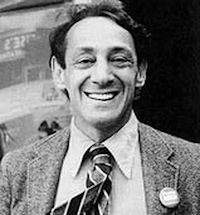
Winner of the 1984 Oscar for Best Documentary, The Times of Harvey Milk is a gripping film that works on almost every level. Informative without being entirely one-sided, it’s also funny and exciting, tragic yet ultimately hopeful. It’s also one of those few movies that likely changed more than a few lives. As the title suggests, the key to understanding Harvey Milk is understanding the time in which he lived. Fortunately for us, filmmakers Rob Epstein and Richard Schmiechen present a wonderful portrait of Milk—San Francisco’s first openly gay supervisor—and the issues, both politically and socially, of the day.
 The film begins with a now-famous piece of footage: Diane Feinstein (then President of the San Francisco Board of Supervisors) announcing to news cameras that her fellow City Supervisor Milk and Mayor George Moscone had been shot and killed, and that former Supervisor Dan White was the prime suspect. The response of the assembled horde is still stirring for its sheer emotion—there are audible gasps, and one unidentified man shouts, “JESUS CHRIST!” It was a shocking act; the reaction is understandable.
Written by Judith Coburn, the documentary makes excellent use of interviews, still photos, recordings and archival footage to tell Milk’s story. A product of middle-class Jewish parents from suburban Long Island, in 1970 at the age of 40, he moved to San Francisco’s emerging gay Castro district and opened the Castro Camera Shop. Turning to political activism, Milk was referred to as “the Mayor of Castro Street” and became known in the community as the one to see about gay business matters–even attracting the teamsters who arranged for him to boycott Coors beer in the Castro area.
In 1973, Milk began running for political office. He lost two bids for the San Francisco Board of Supervisors and one for the California State Assembly, but continued to get more votes each time and gain more political support with each election. He finally won a seat in 1977 as supervisor for the newly zoned District Five that covered the hippie area of Haight Ashbury and the gay Castro section. It was an election that brought cheer to the gay community, who had an official voice for the first time in San Francisco. Fearing a possible assassination because of the political and social climate of hate surrounding his election, Milk tape recorded his story in 1977.
For an 88 minute documentary (narrated by Harvey Fierstein), the structure is a bit surprising. Little time is spent on his childhood or formative years. He is elected at age 48, just 17 minutes into the proceedings. His assassination comes at the 53 minute mark. As it turns out, this was a brilliant decision by the filmmakers, as it allowed them to adopt a traditional three-act structure and limit the bulk of their time to Milk’s 11 months as supervisor.
By keying in on his political career, we see how much of a populist Milk really was. While gay rights were very important to him, he championed the underdog. As in the feature film Milk, quite a bit of time is spent on his efforts to Prop 6 (“the Briggs initiative”), which banned gays and lesbians from teaching in public schools (and could even allow firing teachers who supported gay rights). Some of the best archival footage comes in this section, with Milk and activist Sally Gearhart taking on Briggs in a TV debate, as well as Milk going at Briggs at a public debate and destroying the notion of homosexual or heterosexual “influence.”
Epstein (and co-editor Deborah Hoffman) masterfully intercut Milk’s political triumphs with the parallel rise and fall of Supervisor White, who was elected at the same time as Milk but quickly found himself frustrated by the Board. They then cover his odd resignation and attempt to retract it. The assassination itself is covered by little more than tapes of live news footage and crackling CB radios. It’s all brilliantly effective.
If anyone was to have a gripe with The Times of Harvey Milk, it would be the fact that Milk’s friends are allowed to second-guess the jury, and impugn the jurors motives after White received what was considered a light sentence. “If Dan White had only killed George Moscone, he would have gone up for life,” one person says in the film. “But he killed a gay, and so they let him off easy.”
Without hearing from at least one juror, it’s hard to know if that’s the case. Many have said that it was actually poor prosecution that led to a five year sentence for White. Some of the jurors were presumably available to the filmmakers, and the decision not to let them speak for themselves is a serious bias.
That objection aside, The Times of Harvey Milk is an informative, emotionally absorbing documentary that should be in the collection of anyone who enjoys the genre.
The 1.33:1 image is rather sharp for a 25-year-old documentary originally shot on 16mm. There is some grain present, but the interviews are well saturated and cleanly rendered. Some of the archival footage is in pretty bad shape, but in those cases, historical importance trumps quality.
The DTS-HD Master Audio 2.0 surround track is nothing special but does the job. Music emanates from the surrounds, narration and interviews in the center. It’s not the most dynamic track but the mix is clear and audible, with no issues of note.
We get the following special features:
- Audio Commentary: featuring director/co-editor Robert Epstein, co-editor Deborah Hoffman, and photographer Daniel Nicoletta. Informative and fascinating, we get plenty of background on the making of the film and the director’s attachments to the interviewees.
- Postscript (2:42) is something of an alternate ending, with additional comments by interview subjects Tory Hartman, Kill Kraus, Anne Kronenberg, and Jim Elliot; while they chose the right closing, these are still very interesting.
- John Else (19:48) the UC Berkeley documentary program director takes a frame-by-frame look at the structure and style of the film. He explains why, ultimately, it works so well.
- Two Films, One Legacy (22:57) looks at the Milk story. Tracing its journey from the original documentary to the 2008 docudrama account Milk, via footage from and interviews with participants in both projects (and in the original events). It’s short but fascinating, particularly in Cleve Jones’s account of how the documentaries release found itself eclipsed by the sudden rise of the AIDS epidemic.
- Harvey Milk Recordings: A real gem in the collection, Milk himself, reflects on the following: On the radio reacting to the Dade County repeal (13:51), speaking before the Texas Gay Conference Five in 1978 (47:34), campaigning against the Briggs initiative (2:45), celebrating the defeat of Prop 6 (10:04), and recording his “political will” in 1977 (13:18).
- The “Director’s Research Tapes” (1:19:54) are fascinating, black-and-white videotaped interviews with potential subjects ultimately not included in the film: Milk’s longtime partner Scott Smith, Bay Area Reporter publisher Bob Ross, political organizer Amber Hollibaugh, activist and former Milk intern Cleve Jones, San Francisco Superior Court Judge Lillian Sing, and Hank Wilson, co-founder of the Gay Teachers Coalition.
- From the Castro to the Oscars” features excerpts from the film’s San Francisco premiere at the Castro Theatre (7:36), as well as the 1985 Oscars, where it won Best Documentary (3:06).
- The Dan White Case” combines news clips about Milk and Moscone’s assassin (4:05) with a 2003 panel discussion about the case (29:29), featuring his attorneys Douglas Schmidt and Stephen Scherr and deputy district attorney Jim Hammer.
- Harry Britt, Milk’s Successor (9:49) An excerpt from a moving speech given by Britt on the 25th anniversary of Milk’s assassination.
- Candlelight Memorial (7:20) held on the 25th anniversary, at which longtime San Francisco supervisor Tom Ammiano and Moscone’s daughter Rebecca spoke.
- Theatrical Trailer (3:16)
- Booklet: The 30-page booklet contains cast and crew lists, the chapter listing, a generous selection of photographs, critic B. Ruby Rich’s celebration of director Robert Epstein and his documentary, Harvey Milk’s nephew Stuart Milk’s paean to his uncle, and film restorer Ross Lipman’s discussion on the work that went into restoring the film.