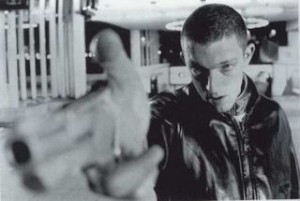
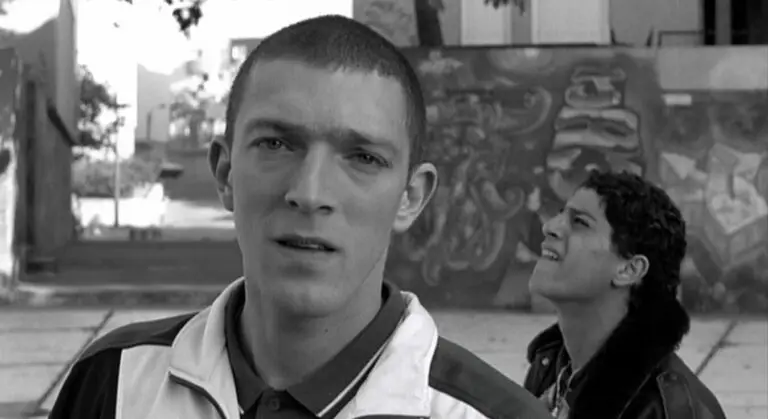
Shot in black and white, and steeped in realism, director Mathieu Kassovitz’s La Haine (“Hate”) is often thought of as France’s answer to Boyz N’ the Hood. Showing gun fights, riots, police brutality, and gang warfare, this sprawling urban drama takes an unflinching look at poverty on the outskirts of Paris. Focusing on three primary characters to represent different alienated French immigrant youth, the narrative follows their aimless existence through a 24-hour period: Vinz (Vincent Cassel) the would-be gangster represents the Jewish working class, Hubert (Hubert Kondé) a boxer is African, and Said (Saïd Taghmaoui) a fast talking schemer, is North African Arab.
The film opens after a violent riot in Paris. In the scuffle, their friend Abdel is seriously hurt, and now lies comatose in the hospital. One of the police officers lost his gun in the may lay, to be discovered by Vinz. For Vinz, who models himself after Taxi Driver’s Travis Bickle, finding the gun becomes a symbol of possessing the power and forcefulness he’s always craved. While Vinz seeks revenge, Hubert is the only one who has a semblance of family life. He’s simply looking for a way out of the ghetto, so he can avoid the same fate as his imprisoned brother. Outspoken, Said often acts as a kind of mediator between his two friends.
Among these disenfranchised French youths, going to jail is looked at as a badge of honor. Guns are looked at with a sense of awe, since they’re not readily available. Since there are so few guns in France, a person such as Vinz can make the transition from victim to enforcer very quickly. Death in the ghetto is seen as inevitable.
As the young men wonder the streets, ducking in and out of their homes, the cinema verite style has an undeniable intensity. Vinz poses in front of the bathroom mirror in the famous Travis Bickle stance, saying, “You talkin’ to me?” in French. When the three friends attempt to visit Abdel in the hospital, they are accosted by the police. When one of the more violent policemen is seen wearing a Notre Dame jacket, this is clearly not a reference to the famous French cathedral, but the American University. The message is that violence knows no bounds—country, race, nationality or otherwise.
Though La Haine is character driven film, the surroundings play an important part in the story. The black and white photography adds to the starkness of the scene. The crumbling buildings suggest that this is an area the government, and perhaps most of its residents, have given up on. Kassovitz is making the argument that kids are the product of their environment. Therefore, if we abandon them and only expose them to violence, we shouldn’t be surprised when they strike back as young adults.
Cited as being from a “New 4K digital master, supervised by director of photography Pierre Aïm and approved by director Mathieu Kassovitz,” this 4K disc presents the film in Dolby Vision HDR. The 2160 image quality advances the already pleasing 1080p disc, originally released in 2012. Presented in the film’s original 1.85:1 aspect ratio and shot on color stock but printed in black and white, giving a bleak tone to the proceedings. Contrast is wonderful, sporting nice, inky blacks and even whites. No digital artifacts are present, and the white subtitles are easy to read.
The DTS-HD Master Audio 5.1 sound mix is largely based in the front. The surrounds really only come into play during musical interludes. Dialogue, centered in the middle channels, has been recorded well. The Bass is not particularly dynamic, so while the sound effects come through fine, this is the one area some may feel is lacking a bit.
English subtitles are available.
The included Blu-ray disc contains the following extras (unless otherwise noted):
- Audio Commentary: the same English-language audio commentary by director Mathieu Kassovitz that appeared on Criterion’s 2007 DVD release of La Haine. (Also on the 4K disc.)
- Introduction (15 min) recorded in 2006, a nice introduction to La Haine by actress and filmmaker Jodie Foster, who helped bring the film to the United States.
- Trailer 1 (1 min) original French theatrical trailer for La Haine.
- Trailer 2 (1 min) original French theatrical trailer for La Haine.
- Deleted and Extended Scenes: Because La Haine was shot on color stock and printed in black and white, these time-coded scenes are in color. Each scene includes an afterword by director Mathieu Kassovitz.
- The Making of a Scene (7 min) raw footage from a scene where Vinz fantasizes about shooting a cop.
- Preparation for the Shoot (6 min) before shooting of La Haine started, director Mathieu Kassovitz, Vincent Cassel, Hubert Koundé, and Saïd Taghmaoui moved to the projects. Here, they reflect on the experience and discuss how it impacted the film.
- Social Dynamite (34 min) sociologists Sophie Body-Gendrot, William Kornblum, and Jeffrey Fagan discuss life in the banlieues and the film’s message, as well as some of the similarities between the banlieues and the projects in America.
- Ten Years of “La Haine” (83 min) produced by Studio Canal, this documentary traces the history of La Haine; from the shooting incident that inspired it, to the film’s success at the 1995 Cannes Film Festival. It includes interviews with director Mathieu Kassovitz, actors Vincent Cassel and Hubert Kounde, and producers Christophe Rossignon and Alain Rocca.
- Booklet: a 21-page illustrated booklet featuring an essay by film scholar Ginette Vincendeau and a 2006 appreciation by acclaimed filmmaker Costa-Gavras.
[rwp-review id=”0″]