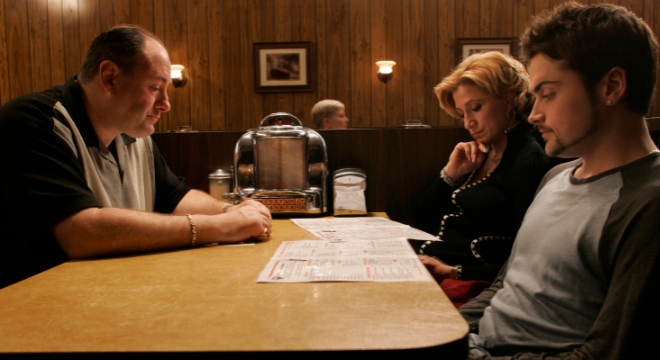
The Sopranos debuted on HBO January 10, 1999, quickly becoming a ratings phenomenon, attracting 12 million viewers at its peak. A complex drama about a mob boss, his family, his crew and his shrink, fascinated viewers and garnered piles of awards. If The Sopranos had been about a tough guy mobster who whacked people and frequented strip clubs, the show likely would have been forgotten. Instead, it was clear from the start that Tony Soprano (James Gandolfini) was a man with some kind of moral code.
As the series begins, Tony is sitting in the office of psychiatrist Dr. Jennifer Melfi (Lorraine Bracco). He has just been told that therapy might help him deal with the dangerous panic attacks, and bouts of depression that have caused him to pass out. Though he initially thinks the idea “absurd,” he agrees to see her, sharing some rather emotional thoughts. Through the years, Dr. Melfi serves as the lone moral voice, in a world where mob rules above all else.
In the first season, The Sopranos showed us how Tony, often with great difficulty, balanced work and family. Tony’s aging paternal uncle Corrado “Junior” (Dominic Chianese), had waited years to take the reigns as acting boss and he resents his nephew for essentially pulling the rug out from under him. Determined to get what he believes is rightfully his, Junior goes as far as to enlist Tony’s mother Livia (Nancy Marchand) in a devious plan to consolidate his power. Tony’s wife, Carmella, (Edie Falco) while aware of her husband’s mafia dealings, attempts to create a semblance of legitimacy for her family. She is also aware that Tony id terminally unfaithful, but enjoys the lifestyle he can provide. His daughter Meadow (Jamie-Lynn Sigler) is an extremely intelligent, but rebellious kid, getting ready to start college, and his only son A.J. (Robert Iler) is turning out to be a lazy trouble maker. To further complicate matters, Tony’s nephew and protégé, is volatile, impulsive, and addicted to drugs.
Though Tony has numerous underlings at his disposal, and access to all the money he could ever need, he’s always right on the edge of self destruction. On the outside, he seems calm enough; day in and day out he deals in a business that makes him enemies puts his life in danger, and leaves those he loves in the crossfire at all times. He does what he needs to do in a workman-like fashion. He is “The Boss,” after all. Nonetheless, almost anything could cause Tony to erupt in a fit of rage. As the years pass, Tony gets better at using people, even killing them seems easier. He’s able to rationalize his actions, seeing himself as a hero-like figure.
Perhaps as a result of his sessions with Dr. Melfi, Tony doesn’t hesitate to pass moral judgment on others, and the fact that he does what he does, to straighten them out. Tony is always looking inward, but it’s to figure out what moral stand he needs to take in order to make a situation work out in his favor. Essentially, instead of talking the lessons learned in therapy to better himself, Tony twists things around to make himself believe that his bad choices are indeed, correct. I guess you could call it reverse psychology!
The Sopranos introduced (and of course, subtracted), numerous characters over the years, and several well known stars—such as Lauren Bacall, Nancy Sinatra, Annette Bening, and Burt Young—would appear in just one or two episodes after the series became a cultural phenomenon. Today, many viewers and critics alike, regard The Sopranos as the best television series ever made. While that point can certainly be debated, it’s impossible to deny that the show changed the face of television, ushering a desire for more realistic, complex programming across the board, networks included. It’s fair to say that many of today’s most popular programs—Game of Thrones, Mad Men, Homeland, Sons of Anarchy, Boardwalk Empire—would not exist if The Sopranos hadn’t changed viewers expectations regarding what television was capable of.
The writing and directing remained top notch throughout most of the series, and the character development could match that found in some of the best films. The attention to detail is obvious, and no matter how many times I watch an episode of The Sopranos, I always want more. Tony and the other characters are so well developed, even if you don’t like them, you want to find out what becomes of them.
Creator David Chase and his team never sat on their laurels, content to enjoy piles of awards. The series ended with one of the most thought-provoking, and ambiguous endings in the history of television. Fifteen years after the finale initially aired, people are still discussing the final shot, and wondering what it all meant. The final episode is also as good as it is because of the 85 largely inspired episodes that came before it. The Sopranos remains as fascinating today as it was when it first aired on HBO.
HBO has brought The Sopranos to Blu-ray via the original broadcast aspect ratio 1.78:1 in 1080p. The image is largely pristine throughout, full of detail and bright, vivid colors. Fine detail is strong, revealing facial features and textures on everything from clothing to background elements. Close-ups are good, but wide shots occasionally look slightly off. Aside from the opening sequence, the image is free from grain of any kind, resulting in a strong, rich image with clean edges. Contrast is terrific throughout, and black levels are robust. Banding, crush, or other digital anomalies aren’t an issue. All and all, HBO has delivered another fine transfer.
The DTS-HS Master Audio 5.1 track presents the series with remarkable clarity. Dialogue is clean, intelligible, and well prioritized as are the ambient effects. Music is robust, but not overbearing. Other elements are balanced nicely throughout as well. A little LFE helps to balance things out further, making this mix likely as good as it will ever be.
Lossless French DTS 2.0, Latin Spanish DTS 2.0, German DTS 2.0, Castilian Spanish DTS 2.0 dub options are provided. Subtitles are included in English SDH (for the deaf and hard of hearing), French, Latin Spanish, German, Castilian Spanish, Dutch, Danish, Finnish, Norwegian, and Swedish.
Most of the material has been ported over from the show’s previous DVD releases, some of which are outdated. This set includes a bonus disc containing all new extras. The new Blu-ray set also adds a digital copy code for the entire series.
Season 1 Extras:
- Interview with David Chase by filmmaker Peter Bogdanovich (77 Min.)
- Behind the Scenes Featurettes:
- “Family Life” (4 min.)
- “Meet Tony Soprano” (4 min.)
- Audio Commentary: “Pilot” with creator/writer/director David Chase and Peter Bogdanovich
Season 2 Extras:
- Behind the Scenes Featurettes:
- “The Real Deal” (5 min.)
- “A Sit-Down with The Sopranos” (14 min.) which features James Gandolfini and other cast members of the series discussing the show and the storyline up to this point in its run.
- Audio Commentaries: “Commendatori” “From Where to Eternity” “The Knight in White Satin Armor” and “Funhouse”. Featuring commentary guests including directors Tim Van Allen, Henry J. Bronchtein, Allen Coulter and John Patterson, and producer Ilene Landress.
Season 3 Extras:
- “Behind the Scenes Featurette” (4 Min.) a brief overview of the making of the show.
- Audio Commentaries: “The Telltale Moozadell” “Pine Barrens” ” and “Amour Fou” featuring commentary guests like writer/actor Michael Imperioli, director Steve Buscemi, and creator David Chase.
Season 4 Extras:
- Audio Commentaries: “The Weight” “Everybody Hurts” “Whoever Did This” and “Whitecaps” featuring commentary guests writers Terence Winter, Michael Imperioli, Robin Green and Mitchell Burgess, and series creator David Chase.
Season 5 Extras:
- Audio Commentaries: “All Happy Families…” “Sentimental Education” “In Camelot” “Cold Cuts” and “Long Term Parking” with directors Peter Bogdanovich, Steven Buscemi, Mike Figgis, and Rodrigo Garcia. Also with actress Drea de Matteo.
Season 6 Part 1 Extras:
- Audio Commentaries: “Join the Club” “Luxury Lounge” “The Ride” “Kaisha” with creator David Chase, writers Terence Winter and Matthew Weiner, and cast members Edie Falco, Robert Iler, Michael Imperioli, Jamie-Lynn Sigler and Tony Sirico.
Season 6 Part 2 Extras:
- Behind the Scenes Featurettes:
- “Making Cleaver” (8 min.) is a pseudo making-of behind the scenes look at Christopher’s horror film.
- “The Music of The Sopranos” (17 min.) features creator David Chase and cast and crew as they discuss the songs from the show and the impact of the music.
- Audio Commentaries: “Soprano Home Movies” “Remember When” “The Second Coming” and “The Blue Comet” with commentary guests like cast members Dominic Chianese, Robert Iler, Arthur Nascarella, Steven R. Schirripa, and Stevie Van Zandt.
Special Features Disc:
- Defining a Television Landmark (HD, 45 min.) Including some archival footage featuring the late James Gandolfini and the late Nancy Marchand, mixed with film critics, scholars, actors, and filmmakers, this piece examines the legacy of The Sopranos. Steve Buscemi, Steven Soderbergh, Elvis Mitchell, David Chase, and others offer up their thoughts.
- Supper with the Sopranos (HD, 74 min.) David Chase is joined by Terence winter, Alan Coulter, Aida Toturro, Dominic Chianese, and Robert Iler as they discuss various issues regarding the show. The ending dominates much of the beginning, and the participants are surprisingly candid about the affect the show had on their lives.
- Lost Scenes (SD, HD, 22 min.) highlights deleted scenes from the entire run of The Sopranos with a few moments taken from each season.
- Alec Baldwin Interviews David Chase (HD, 43 min.) In this interview cut into two parts, Chase discusses wanting to be a filmmaker but ending up in television. He also discusses his creative process.