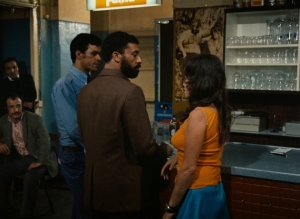
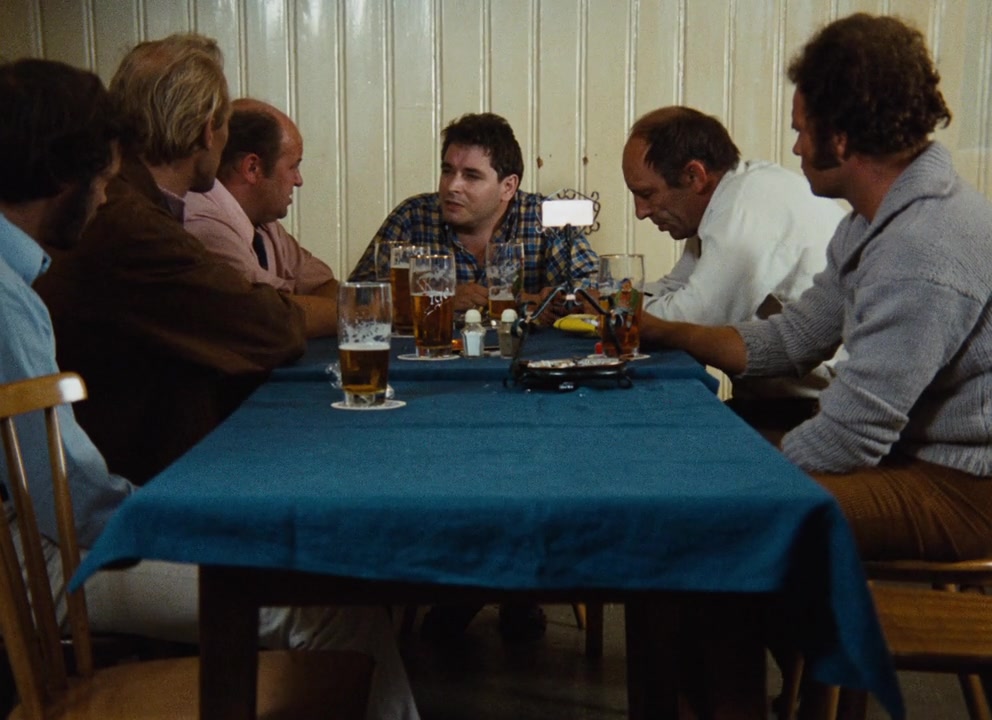
Often after watching a film by Rainer Werner Fassbinder I find myself both mentally and physically exhausted. His style is unrelenting; often harsh. His character’s emotions exist right on the surface; they hide little, almost appearing to exaggerate everything they do. And yet given the bleak worlds in which Fassbinder’s character’s exist, this is understandable. Sustained happiness isn’t possible in the face of such an unpleasant, suffocating existence. Such is the case with The Merchant of Four Seasons.


Hans Epp (Hans Hirschmuller), is a portrait of self-loathing. Nothing in life has gone his way. He joined the Foreign Legion then the police force, only to be fired after being caught in his office with a prostitute. He then becomes a fruit seller, hawking his wares on the streets, shaming his bourgeois family—particularly his corrosive mother (Gusti Kreissl). Hans has only two true pleasures in life, drinking (often heavily), and his former girlfriend and one true love (ingrid Caven). Understandably, both are unpopular with his wife, the occasionally manipulative but demoralized Irmgard (Irm Hermann). While the couple barely make ends meet, Hans doesn’t blame anyone but himself for his misery. Nonetheless, he can’t stand the fact that his wife doesn’t trust him. One day while in a drunken stupor, Hans beats his wife in front of their beautiful, young daughter Renate (Andrea Schober).
After his wife leave him, and a heart attack land him in the hospital, Hans turns his life around; finding success in business and even earning praise from his family. However, deep down he still as depressed as ever, and no amount of success is going to change that. Watching his descent into a deep, unforgiving hopelessness is heartbreaking—this is truly a man that can find absolutely nothing in society worth holding on to. In turn, society doesn’t care enough to lift him up.
The story is told a fractured narrative of present tense and flashback. The source of Hans’ misery is Hans’ attempt and failure to live up to expectations of his family and their social status. Everything he ever wanted to be, a mechanic, a member of the Legion, was beneath them. When Hans had proposed to his great love, she had refused, saying her father would never approve of his ambitions (or lack thereof). Hans is deemed a failure by his own mother, and his own wife cheats on him, and regularly mocks him. While it’s hard not to feel sorry for Hans much of the time, he’s also a nasty man who beats his wife—in a scene brilliantly filmed by Fassbinder.
In truth, Hans’ story is one of a man who is trapped in the web of depression, and it eventually becomes clear that its one he won’t escape. Saddest of all, his family seems happier once he’s gone.
Presented in the 1.37:1 aspect ratio, Criterion’s new 4K, 1080p restoration looks beautiful. While the film stock itself isn’t particularly lush, we are given fine grainy detail. The film grain is table and well rendered, with no serious damage to the print apparent. Colors are slightly muted, but appropriated. Black levels are consistent and deep. I think it’s pretty safe to say that this is as good as this film is ever going to look.
The LPCM 1.0 mono German audio track is just as strong. Dialogue is clean and clear throughout with no hiss or distortion.
English SDH subtitles are included.
The following extras are available:
- Audio Commentary with Filmmaker Wim Wenders: Recorded in 2002, Wenders discusses his friendship with Rainer Werner Fassbinder, the differences and similarities between the two men’s filmmaking styles, working in Germany, camera use, and more.
- Irm Hermann Interview (HD, 9:13) Recorded exclusively for Criterion in Berlin in February 2015, Hermann (Irmgard) recalls her first encounter with Rainer Werner Fassbinder who convinced her that she should be an actress (prior to their meeting Irm Hermann was making ends meet as a clerk in an office), discusses his directing methods, the “difficult” nude scene with Karl Scheydt in The Merchant of Four Seasons, The Federal Film Award she received in 1972, and more.
- Hans Hirschmüller Interview (HD, 13:25) Recorded exclusively for Criterion in Berlin in February 2015, Hans Hirschmüller (Hans Epp) discusses his character, some of the locations in Munich where the merchant sells his produce, his dealings with Rainer Werner Fassbinder during filming, and more.
- Eric Rentschler Interview (HD, 26:10) Recorded exclusively for Criterion in Cambridge, Massachusetts, in February 2015, the film historian and Professor discusses the significance of The Merchant of Four Seasons in Rainer Werner Fassbinder’s body of work, the social commentary on post-war reality in Germany, some of the contrasts in the film, and more.
- Leaflet: Illustrated leaflet featuring Thomas Elsaesser’s essay “Downward Mobility in Munich.”