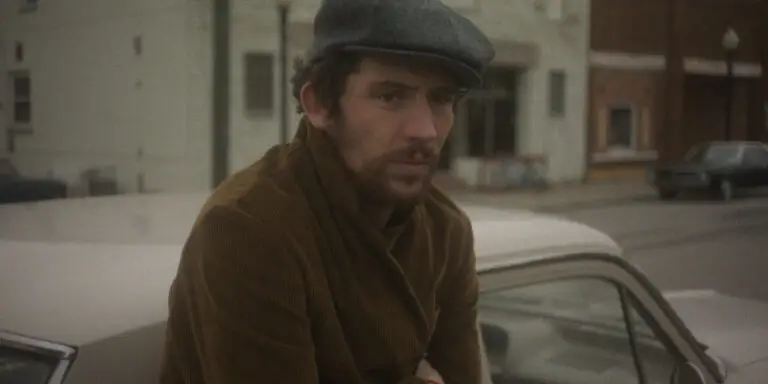
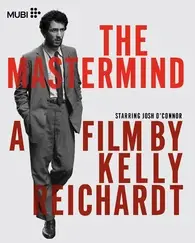
Writer/director Kelly Reichardt’s The Mastermind is both a character study and a heist film. Set in Framingham, Massachusetts,1970, James Blaine “J.B.” Mooney (Josh O’Connor), is an unemployed carpenter, art school dropout, and would be thief. JB orchestrates the theft of four modernist Arthur Dove paintings from the local art museum. Married to Terri (Alana Haim) and the father of two sons (Jasper Thompson and Sterling Thompson) he cases the museum during a family outing.
From a well-to-do family, J.B.’s father (Bill Camp) is a judge. His mother Sarah (Hope Davis) agrees to give him money for a new project, but little compassion. J.B. uses that money to pay two unreliable hoods (Eli Gelb and Cole Dolman) and a third guy who provides a getaway car but backs out of the heist at the last minute. Predictably, several things go wrong, forcing J.B. to go on the run, abandoning his family. He attempts to hide out with college friends Fred (John Magaro) and Maude (Gabby Hoffman, in a small, but important role), who insist J.B. leave before taking them down with him.
Inspired by a 1972 theft at the Worcester Art Museum and the films of Jean-Pierre Melville, the snappy opening credits suggest that The Mastermind is going to be a slick heist film, but it quickly becomes clear that J.B. has little drive Josh O’Connor effectively communicates J.B.’s long simmering anger, and his unwillingness to accomplish anything through honest work. One memorable scene finds J.B. struggling to hide the paintings in the loft of a remote barn. Nothing goes right for him, yet J.B. continues this path despite the obvious failure that awaits.
While the slow pace of The Mastermind can occasionally be tedious, careful attention to the 1970’s set design deposits you in that era. With the Vietnam War in the background—in the form of protesters and TV news reports—perhaps J.B.’s motivation for the robbery is a rebellion against the establishment his father the judge is a central part of. Or is J.B. just a crook that can’t be trusted? Whatever the answer, Kelly Reichardt removes the glamour often associated with heist films, focusing instead on the loneliness of life outside the law.
Presented in the 1.78:1 aspect ratio, this 1080p transfer perfectly preserves Reichardt’s 1970’s aesthetic. Fine detail looks natural throughout—be it the fine weave of J.B.’s woolen garments or the woodgrain present in his modest home—clarity is impressive. The image itself is rather flat, adding to the drab, hopeless nature of the story. Shadow delineation is strong throughout, creating a strong sense of place. Blacks are inky, and the image is clean, devoid of any digital noise or other anomalies.
The English DTS-HD MA 5.1 soundtrack sounds natural, offering surprising dynamic range. Rob Mazurek’s jazzy score benefits, exhibiting welcome crispness throughout, and wonderful fidelity. Surrounds offer a gentle mix of natural ambient sounds well mixed, the dialogue is clean, crisp, and concise throughout. there are no pops, dropouts, or other anomalies present.
English SDH, English, French, French SDH, Spanish, Spanish SDH subtitles are available.
The following extras are included:
- Unwinding the Heist Film (HD, 14:28) A visual essay from film programmer Amos Levin, it includes remarks from writer/director Kelly Reichardt.
- Picture Cards (6 in total)