

Returning home from a swanky party, Dr. Richard Kimble (Harrison Ford) discovers his wife (Sela Ward) has been shot and is dying on the bedroom floor while an unknown one-armed man is fleeing the scene (Andreas Katsulas). Kimble has little time to mourn the loss, as he is tried and wrongly convicted of her murder. On the bus ride to the prison, Kimble is accompanied by three other prisoners. When they attempt an escape, the driver of the bus loses control and it plunges down an embankment. Kimble finds himself free. Ninety minutes later, Federal Deputy Marshal Sam Gerard (Tommy Lee Jones) arrives on the scene to coordinate the search for the fugitive. While Kimble evades Gerard and his men, he also begins the hunt for the one-armed man.
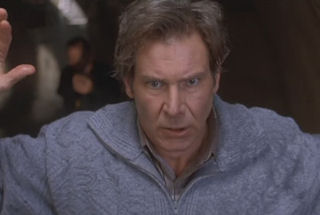 Unlike the television series, which had David Jansen’s Kimble engaging in a secondary story each week, the film is solely about the chase and catching the criminal. Oddly though, even though this is a chase movie, the scenes before the chase begins are some of the best. In a well edited fifteen minute prologue we are given a look at the circumstances surrounding the murder and the trial. While we don’t get a lot of information regarding Kimble’s relationship with his wife, it’s clear that they loved each other. By the time he’s convicted of killing her and the sentence had been read, we understand the double tragedy Kimble is dealing with.
After the prologue, we are treated to non-stop action as Gerard and his men track down Kimble. Directed and photographed with a sense of urgency, viewers are on edge as Kimble attempts to stay ahead of his would be captors. Kimble and the lawmen are all intelligent people, which makes the chase even more intriguing, That isn’t to say that the plot is airtight. A few things are contrived to bring about a tidy resolution.
Kimble’s pursuit of the one-armed man often seems a little too pat. Clues are just a little too easy. The murder mystery just isn’t as well constructed as it could be. If it had been, the plot would have been a little tighter and we would have had a better understanding of some of the motivations of secondary characters. Despite these issues, The Fugitive is still a solid murder mystery.
While Harrison Ford does a fine job as Dr. Richard Kimble, this film really belongs to Tommy Lee Jones. His character has undeniable charisma and palpable energy. Gerard’s growing respect for Kimble is obvious. Jones deserves a lot of credit for making a seemingly straightforward character into something special.
Presented in its original 1.85:1 ratio, Warner has provided an excellent 1080p transfer. The picture is mostly clear and grain free throughout, though there are a few scenes where the color looks a bit weak. The film’s cinematography is pleasing throughout, adding to the overall visual appeal.
The lossless DTS-HD MA 5.1 track provides solid support to the film. Though dialogue centric, the sonic mix provides a nice heft to sound effects—the bus crash, the roar of water running through a dam—and sound to James Newton Howard’s excellent score. Dialogue is clear throughout.
English SDH, French, Spanish, Portuguese, Japanese, Italian SDH, Croatian, Czech, Greek, Hungarian, Korean, Mandarin (Simplified), Polish, Russian, Thai and Turkish subtitles are included.
The following special features are available:
- Commentary by Andrew Davis and Tommy Lee Jones: The two are connected by telephone and Davis does the bulk of the talking. Davis provides quite a bit of information in regards to the staging of the film’s action scenes, and the shooting process. Tommy Lee Jones only offers his thoughts when prodded by the director.
- Introduction by Andrew Davis and Harrison Ford (SD, 1:52) The first few minutes of what’s heard in the commentary was apparently filmed.
- On the Run with The Fugitive (SD, 23:06) A nice look at the shooting of the film. Most of it concerns the action sequences, but it’s interesting to see how the on location scenes were done.
- Derailed: Anatomy of a Train Wreck (SD, 8:55) A brief look at the opening action sequence. The train wreck was actually shot at full scale, rather than using miniatures.
- Theatrical Trailer (SD, 2:02)
- The Fugitive: Thrill of the Chase (HD, 28:21) This retrospective documentary boasts an impressive array of people involved in the film, all of whom share their perspectives. Participants include Ford, Jones, Andrew Davis, Joe Pantoliano, Jane Lynch, co-editor Don Brochu, producer Arnold Kopelson and co-producer Peter Macgregor-Scott. Film critic Kenneth Turan also chimes in, as does Bob Herzberg, author of The FBI and the Movies.
- The Fugitive TV Pilot (HD, 45:28) The pilot of the short-lived 2000 television series. It starred Tim Daly as Kimble and Mykleti Williamson as Lt. Gerard, now a police detective in Chicago who conducted the original investigation into the murder of Helen Kimble. Let’s just say the pilot was awful, and leave it at that.