
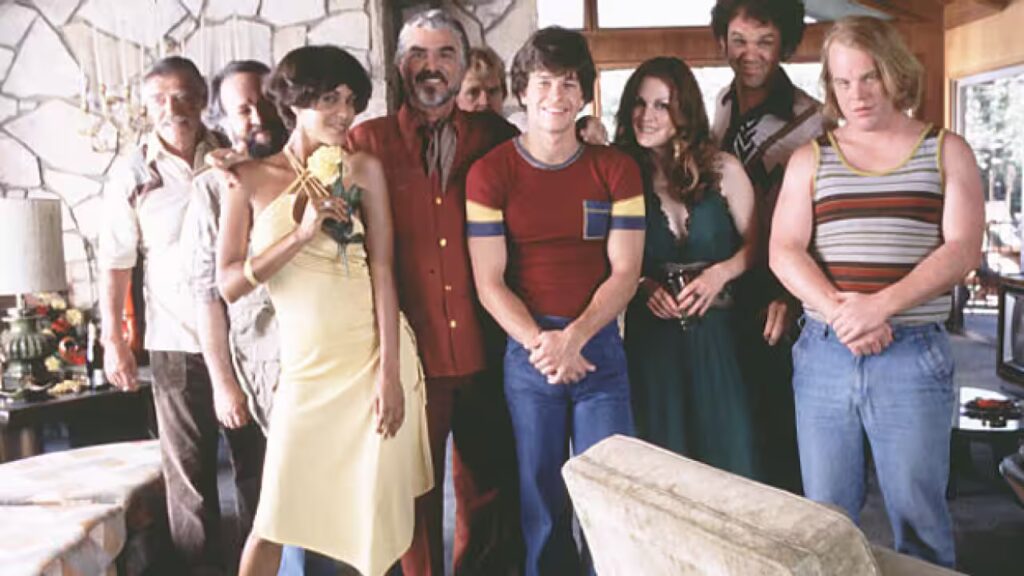
 “Everyone is blessed with one special thing,” says Mark Wahlberg as Boogie Nights’ Dirk Diggler, a rising star in the pre-AIDS heyday of 1970s porn. And Dirk’s special thing is his special thing. That is—and there’s no way to put this politely—his massive member, always ready for action. Boogie Nights was director/writer Paul Thomas Anderson’s second film, and the one that put him on the map; garnering several Oscar nominations including Best Original Screenplay for Anderson. Make no mistake, Boogie Nights is far from a tribute to masculinity. While Dirk’s member drives the plot, it is also exposed as being meaningless in the big picture.
In a sweeping four-minute tracking shot, Anderson introduces nearly all his main characters and sets the atmosphere for what is to come. It’s 1977 at a San Fernando Valley nightclub. We first meet Jack Horner (Burt Reynolds), a successful director of adult films. While he and his extended “family” have their night out, Horner eyes one of the club’s young dishwashers, Eddie Adams (Mark Wahlberg). Eddie longs to be somebody, someone other than the stupid loser his mother has called him all his life. Discovered by Jack, Eddie soon changes his name to Dirk Diggler and becomes one of the biggest stars in the porn industry. Eventually, success goes to his head, and a downfall is inevitable. Anderson and the actors make this rather familiar story surprisingly interesting.
Along with Dirk and Jack, Boogie Nights is filled out by a host of other characters. Julianne Moore plays Amber Waves, Jack’s biggest female star, who longs to reconnect with her daughter, but her ex-husband (John Doe) adamantly denies her the chance. To fill the void, Amber becomes a surrogate mother to at least one of the younger female stars, Rollergirl (Heather Graham), a high-school dropout looking for glamour, money, and excitement. John C. Reilly plays Reed Rothchild, one of Jack’s established porn stars, initially a rival and then best friend of Eddie. Don Cheadle is a porn star with a “cowboy” look, who dreams of owning a hi-fi store. William C. Macy plays Little Bill; a poor schmuck whose wife (real-life porn star Nina Hartley) continuously humiliates him with her public sexual antics. Philip Seymour Hoffman is Scotty J., Jack’s lighting guy who has a crush on Eddie. And Luis Guzman plays Maurice TT Rodriguez, a nightclub owner who says he wants to leave a legacy to the world; in other words, he wants to be in some of Jack’s films.
Some other recognizable names pop up in the film. Among them are Philip Baker Hall, Thomas Jane, Alfred Molina, Micheal Penn, Robert Downey, Sr., Jack Riley, Melora Walters, and Nicole Parker. If you turn away, you might miss some of them.
Anderson sets Boogie Nights from 1977-85. In 1977, so-called “adult” movie theaters were doing big business throughout the country, but by the mid 1980’s VCR’s and videotape put most of them out of business. The industry changed, just as the country changed from the permissive 70’s to the far more conservative 80’s. We see these changes reflected in the characters and their lives in the film. In the beginning everyone is relatively happy; yes, people do coke but nobody’s getting hurt and the money’s flowing. At the dawn of the 1980’s, Jack is forced to deal with changes to videotape, and Dirk’s increasing drug addiction means his member is no longer at the ready. By the end, Dirk may be right back where he started from.
At over two-and-a-half hours, Boogie Nights runs a bit long. Despite that, Anderson has still crafted an amazing film that deftly examines the cultural shifts of the 1970’s. Outwardly, Boogie Nights is a movie about the porn industry, but on a deeper level, Anderson was saying something about how the freewheeling seventies laid the groundwork for the conservative movement of the eighties.
Boogie Nights’ new 4K with HDR10 is a strong one. Presented in the 2.35:1 aspect ratio. The use of HDR10 results in wonderfully vivid colors throughout. Standouts include the blue, green, and pink lights inside the Hot Traxx nightclub, Dirk’s burgundy leisure suit, and the intensely red blood hemorrhaging from the nose of an underage coke whore. Black levels are as inky as they could be, without the danger of crushed shadow detail, and contrast is perfect. Some of the scenes—like the hot tub sequence—are remarkably dimensional and lifelike. There’s a lot of handheld camerawork in the film—scattered in amongst Anderson’s long, sweeping, highly orchestrated dolly movements—so the focus isn’t always precise, but this lends to the beauty and feel of the film. In general, Boogie Nights boasts an impressive sense of clarity on 4K, with lots of fine texture apparent in faces and newfound detail in the 1970s costumes. Overall, this is a visually stunning experience.
The DTS-HD 5.1 Master Audio track appears to be the same one available on the 2010 Blu-ray release. Boogie Nights has a soundtrack filled with disco and funk classics the fill the entire soundfield with dimensionality.
Dialogue is clean, crisp and well prioritized, even when characters overlap each other Additionally, sound effects are strong and dynamic, without ever overwhelming. Between the dialogue and the music, there’s always something going on, with the full breath of the speaker system being utilized. Even in the quieter scenes, there’s a level of ambience and atmosphere that adds extra punch to the story.
English SDH, French, and Spanish subtitles are available.
Most of the extras have been ported over from the 2010 Blu-ray, unless otherwise noted:
- Two Audio Commentary Tracks: Both of them are absolutely must listen. The first is Paul Thomas Anderson alone. He’s totally engaging, always swearing and pointing out what sequences he distilled from one of his favorite directors. He’s also young enough to have listened to other directors’ commentary tracks, which makes him an even savvier guide to the film. Also included is a track with Paul Thomas Anderson and several members of the cast (Mark Wahlberg, John C. Reilly, Don Cheadle, Julianne Moore, William H. Macy, Luis Guzman and Heather Graham). The track is P.T.A. interviewing one actor or a couple of actors and then he spliced the whole thing together. Why this works better than most is the way that he edited it. For example, in one scene Mark Wahlberg talks about how Luis Guzman was high. Later, PTA asks Guzman if he was high, citing his previous conversation with Wahlberg. Both tracks are essential.
- NEW!! American Cinematheque Panels (two clips, 50:27 total) Recorded in 2023, the American Cinematheque hosted a five-night event at the Aero Theatre in Santa Monica featuring Boogie Nights in 70mm with live panels featuring director Paul Thomas Anderson and actor John C. Reilly. Among the many topics discussed included casting the film, filming challenges, the rehearsal process, the shoot, and more.
- The John C. Reilly Files (15:10 total) In these outtakes and longer cuts of existing scenes, Reilly has some fun improvising. Three scenes are included: “Swim Trunks,” “Waiting for Todd,” and “Mixing with Nick.”
- Deleted Scenes (29:28) Ten scenes in all, which offer some unexpected gems.
- Music Video: “Try” by Michael Penn (3:11) P.T. Anderson directed this impressive single-shot music video, which is “set in the longest hallway in North America,” according to Anderson’s optional commentary.