Image Entertainment | 1963 | 935 mins. | PG
The fourth season of The Twilight Zone brought with it lots of changes. The most notable to the casual viewer was a shift from its highly effective half-hour format to the more experimental hour-long format that was being implemented by other CBS series, Alfred Hitchcock Presents and Gunsmoke. Behind the scenes, even more seismic changes were taking place. Rod Serling, the show’s creator, and creative force, had accepted a teaching job at Antioch College in Yellow Springs, Ohio. While he would write several scripts this season, he no longer supervised the day-to-day production. Further, producer Buck Houghton, who had been instrumental in getting The Twilight Zone on the air, took another job when CBS waited to renew the series.
 Given all of these changes, it should come as no surprise that the fourth season of The Twilight Zone (technically renamed to just Twilight Zone) contains 18 rarely syndicated episodes. While they’re not terrible, they don’t meet the standard set by previous seasons.
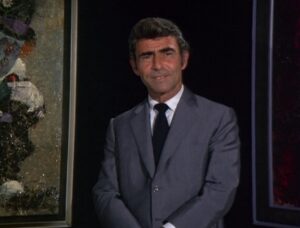
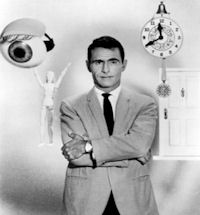
With producer Buck Houghton gone, CBS turned to Herbert Hirschman to guide the series. While he kept much from his predecessor, he did make one notable change. Getting rid of the concentric spiral effect from the third season, and altering the narration a bit. The series now opened with a series of objects floating through space: a shattered window, a detached eyeball (and upper lid), a closed door, and a ticking clock. Very effective; even if fans of the show don’t particularly care for this season’s episodes, the opening is likely remembered. Rod Serling not being available at all times in California has a disconcerting effect on all the episodes. His on-screen introductions were no longer done from the set. Instead, each episode is introduced by Rod either standing or sitting on a stool in front of a blank canvas. That mode of doing things just takes some of the fun and excitement out of it.
Serling contributed only seven scripts—still more than any other writer—while frequent collaborator Charles Beaumont went to work, despite suffering with the beginning stages of both Alzheimer’s and Pick’s disease. Beaumont’s episodes are some of the most memorable of the season. His opener, “In His Image,” is a slow-building mystery about an out-of-control android who, after realizing that he isn’t human, confronts his identical maker. In “Miniature,” a young Robert Duvall (you won’t recognize him), plays a socially stunted thirty-year-old virgin who falls in love with the tiny inhabitant of a museum dollhouse, and character actor Burgess Meredith makes his fourth and final Twilight Zone appearance in “Printer’s Devil” as a typesetter and journalist of soulless disposition. These are all piercingly written and make good use of the hour-long format. Beaumont also wrote the scariest episode of the season, “The New Exhibit,” which follows the descent into madness of a man who keeps wax figures of history’s most notorious serial killers in his basement.
I Am Legend author Richard Matheson wrote two scripts. “Mute,” which asks the question: Would a speechless-but-telepathic orphan be better off in life if she abandoned her gift and became “exactly like everybody else,” as her domineering schoolteacher requires? “Death Ship” centers on three astronauts—one played Jack Klugman—land on a far-flung planet, and find a crashed copy of their ship, with their own dead, doppelganger bodies inside. A haunting and surreal episode, I think it’s my favorite of the season.
Serling himself felt that the hour-long format wasn’t a great idea for the series. “Ours is the perfect half-hour show,” he said. “If we went to an hour, we’d have to fleshen our stories, soap opera style. Viewers could watch fifteen minutes without knowing whether they were in a Twilight Zone or Desilu Playhouse.”
Here’s a rundown on the 18 episodes from season four, with descriptions taken from a full-color bi-fold that also lists original airdates and bonus features for each disc:
“In His Image.” Alan Talbot doesn’t understand why his home town seems so nfamiliar, why he is driven to kill and what those noises are in his head.
“The Thirty-Fathom Grave.” A mysterious clanging sound is heard from within a submerged submarine–20 years after it was sunk by the Japanese during WWII.
“Valley of the Shadow.” Philip Redfield (Ed Nelson) finds himself trapped in a small town where people can reverse time and do many other amazing things. He is determined to escape and share the town’s secrets with the outside world.
“He’s Alive.” Peter Vollmer (Dennis Hopper), a small-time neo-Nazi leader, yearns for more power. Advised by a shadowy benefactor, Vollmer’s followers grow, as does his ego.
“Mute.” A 12-year-old girl (Ann Jillian) who loses her parents in a fire doesn’t speak because she has grown up in a telepathic community. The couple (Frank Overton, Barbara Baxley) who takes her in, and her teacher (Irene Daily), are determined to help her adapt to their society, no matter the cost.
“Death Ship.” Three astronauts discover a wrecked duplicate of their spaceship and their own dead bodies. Determined to prove that they are alive, Captain Ross (Jack Klugman) launches their spaceship again . . . and again.
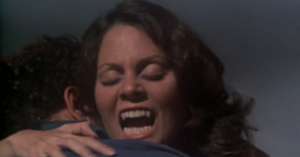
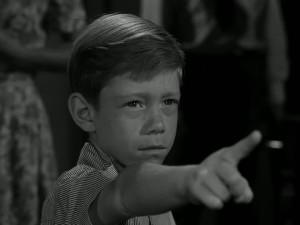
“Jess-Belle.” Billy-Ben Turner (James Best) finds himself enchanted by the beautiful Jess-Belle (Anne Francis), who soon learns the danger of buying a love spell from a witch.
“Miniature.” Charley Parkes (Robert Duvall) is a shy bachelor who discovers a miniature doll apparently alive inside a 19th century dollhouse. Fascinated, he whiles away the hours peering into this little world and wishing he were part of it.
“Printer’s Devil.” When a newspaper editor is at the brink of suicide as his paper is being driven out of business, the devious Mr. Smith (Burgess Meredith) presents an unusual deal guaranteed to boost circulation.
“No Time Like the Past.” Paul Driscoll (Dana Andrews) travels back in time to try to prevent some of history’s catastrophes. Unsuccessful, he decides to stay in the past without interfering until disaster strikes closer to home.
“The Parallel.” Astronaut Robert Gaines (Steve Forrest) finds himself back on Earth in a world very similar to, but not quite his own. Even his wife and daughter seem to be strangers.
“The New Exhibit.” The curator (Martin Balsam) of a murderer’s row in a soon-to-be-defunct wax museum persuades the owner to let him keep the figures for a while. When his wife attempts to destroy them, a new murderous rampage begins.
“Of Late I Think of Cliffordville.” William Feathersmith (Albert Salmi), a bored, wealthy businessman, gets a chance to go back in time and start over, armed with all the knowledge he’s acquired–an arsenal that’s not as powerful as he thinks.
“The Incredible World of Horace Ford.” Toy designer Horace Ford (Pat Hingle) spends most of his time reminiscing about his idyllic childhood. But when he gets the chance to go back to those years, he gets a bitter taste of reality.
“On Thursday We Leave for Home.” William Benteen (James Whitmore) has been the unquestioned leader of a stranded outpost in space for 30 years. But when a rescue ship usurps his power, he tries to force the colonists to remain.
“Passage on the Lady Anne.” In an effort to save their marriage, a young coupe books passage on an old ship, which long ago was reserved for lovers. Former passengers, all now over 75, have gathered for a mysterious voyage.
“The Bard.” Jack Weston is an untalented would-be TV writer whose career takes off when the ghost of William Shakespeare writes his script. Shakespeare is appalled by the sponsor’s changes, including the casting of a macho-type actor (Burt Reynolds) to play the lead.
The Twilight Zone: Season 4 comes to Blu-ray presented in the original 1.33:1 aspect ratio. As with previous seasons, black levels are strong, and the level of detail is superb. There are occasional appearances of noise, but overall, edge delineation is very impressive. Backgrounds have minimal grain.
There are two choices for audio. The original mono is provided for purists. The uncompressed PCM format is richer in tone and free of white background noise. It’s a precise-sounding audio that matches the video frame-by-frame for quality. The only subtitles are in English SDH.
Once again, Image has delivered an impressive package of special features. We get fifteen commentary tracks–thirteen of them specifically recorded for this Blu-ray set–from The Twilight Zone Companion author Marc Scott Zicree, TV/Film historian Gary Gerani, and other guests, including Twilight Zone writer Earl Hamner, Logan’s Run writer William F. Nolan, Fringe and Battlestar Galactica writer/producer Joseph Dougherty, and more. You’ll also find vintage audio recollections, video interviews, sponsor billboards, isolated scores for all eighteen episodes—presented in Dolby Digital 2.0—and some bonus items on the fifth disc. Note that the previews for “Next Week’s Show” are automatically tagged to the end of each episode. Here’s a full breakdown of everything that’s featured:
#103 In His Image
- Commentary by Marc Scott Zicree
- Zicree Interview: Herbert Hirschman, 1978 (52:11)
- Isolated Score
- Sponser Billboards (00:17)
#104 The Thirty Fathom Grave
- Commentary by Gary Gerani and Marc Scott Zicree
- Isolated Score
- Sponsor Billboard
- Radio Drama starring Blair Underwood (44:14)
#105 Valley of the Shadow
- Interview with Morgan Brittany (SD, 7:24): Former child actor Morgan Brittany talks about her experiences on The Twilight Zone.
- Isolated Score
- Sponsor Billboard
#106 He’s Alive
- Rod Serling Blooper (SD, 00:12): Serling hilariously fudges his opening narration.
- Isolated Score
- Sponsor Billboards
#107 Mute
- Isolated Score by Fred Steiner
- Sponsor Billboards
#108 Death Ship
- Commentary by Marc Scott Zicree
- Zicree Interview: Ross Martin (52:04)
- Isolated Score
- Sponsor Billboards
#109 Jess-Belle
- Interview with Anne Francis (SD, 8:11)
- Commentary by Earl Hamner and Marc Scott Zicree
- Zicree Interview: Earl Hamner, Buzz Kulik, Anne Francis (52:11)
- Isolated Score by Van Cleave
- Sponsor Billboards
#110 Miniature
- Commentary by William Windom
- Commentary by William F. Nolan and Marc Scott Zicree
- Isolated Score by Fred Steiner
- Sponsor Billboards
#111 Printer’s Devil
- Commentary by Bill Warren and Marc Scott Zicree
- Zicree Interview: Burgess Meredith
- Isolated Score
- Sponsor Billboards
#112 No Time Like The Past
- Isolated Score
- Sponsor Billboards
- Radio Drama starring Jason Alexander
#113 The Parallel
- Video Interview with Paul Comi (SD, 8:26)
- Commentary by Marc Scott Zicree
- Isolated Score
- Sponsor Billboards
- Radio Drama starring Lou Diamond Phillips
#114 I Dream of Genie
- Interview with John Furia, Jr. (SD, 9:16)
- Isolated Score by Fred Steiner
- Sponsor Billboards
#115 The New Exhibit
- Commentary by Bill Warren and Marc Scott Zicree
- Commentary by Scott Skelton and Jim Benson
- Isolated Score
- Sponsor Billboards
#116 Of Late I Think of Cliffordsville
- Isolated Score
- Sponsor Billboards
- Radio Drama starring H.M. Wynant
#117 The Incredible World of Horace Ford
- Commentary by Jeff Vlaming and Marc Scott Zicree
- Zicree Interview: Pat Hingle
- Isolated Score
- Radio Drama starring Mike Starr
#118 On Thursday We Leave for Home
- Commentary by Joseph Dougherty and Marc Scott Zicree
- Commentary by Scott Skelton and Jim Benson
- Isolated Score
- Sponsor Billboards
- Radio Drama starring Barry Bostwick
#119 Passage on the Lady Anne
- Isolated Score by Rene Garriguenc
- Sponsor Billboard
#120 The Bard
- Commentary by Bill Warren and Marc Scott Zicree
- Isolated Score by Fred Steiner
- Sponsor Billboards
- Radio Drama starring John Ratzenberger
Additional Bonus Features
- Saturday Night Live Clip (SD, 4:34): A vintage SNL clip aping the style of the Twilight Zone, featuring Dan Akroyd as Rod Serling.
- Genesee Beer Commercial (SD, 00:33): Rod Serling pitches Genesee.
- The Famous Writers School Promo (SD, 5:54): A promo for Serling’s correspondence school for young writers.
- Zicree Interview: George T. Clemens, Part 4 (SD, 29:57): The fourth part of a long interview with cinematographer George T. Clemens. The other parts can be found in the Blu-ray sets for the previous seasons.