Adapted from Margaret Mitchell’s 1936 novel of the same name, the theatrical version of Gone with the Wind (GWTW) is still largely considered the prototype for the Hollywood blockbuster. When adjusted for inflation, GWTW remains the highest grossing film of all time in North America and the UK. When the Civil War drama made its network television debut in November of 1976, it became at that time the highest-rated television program ever presented on a single network. GWTW was watched by 47.5 percent of the households sampled in America, and 65 percent of television viewers. Ironically, it was surpassed the following year by the mini-series Roots, an epic about slavery in America.
While many aspects of GWTW may appear antiquated to modern audiences, like The Wizard of Oz, most will see the film at least once in their lifetime. Most are familiar with the story: At the start of the film, Scarlett O’Hara (Vivien Leigh) is a pampered, fiery, teenager in love with Ashley Wilkes (Leslie Howard); she becomes angry when he announces plans to marry her cousin Melanie (Olivia de Havilland). Scarlett’s father (Thomas Mitchell) tries to teach her that Tara, the family plantation, offers something more enduring than the finding of a husband, but Scarlett can only think of her broken heart. To add insult to injury, a cocky miscreant named Rhett Butler (Clark Gable) has witnessed Ashley giving her the brush-off. But then the war breaks out, and nothing will ever be the same for her—or the South.
Produced by David O’ Selznick and helmed by no less than three directors—George Cukor (The Philadelphia Story), Sam Wood (The Pride of the Yankees) and Victor Fleming (The Wizard of Oz), who directed the final product. Production designer William Cameron Menzies apparently had a hand in things as well. Selznick’s pursuit of perfection when it came to GWTW has been discussed and written about extensively through the years. Clearly, it paid off. The film won eight Academy Awards, for Best Picture, Director, Actress, Supporting Actress, Writing, Art Direction, Cinematography, and Film Editing. It was producer David O. Selznick’s crowning achievement and a film that stands up as one of the screen’s most enduring classics.
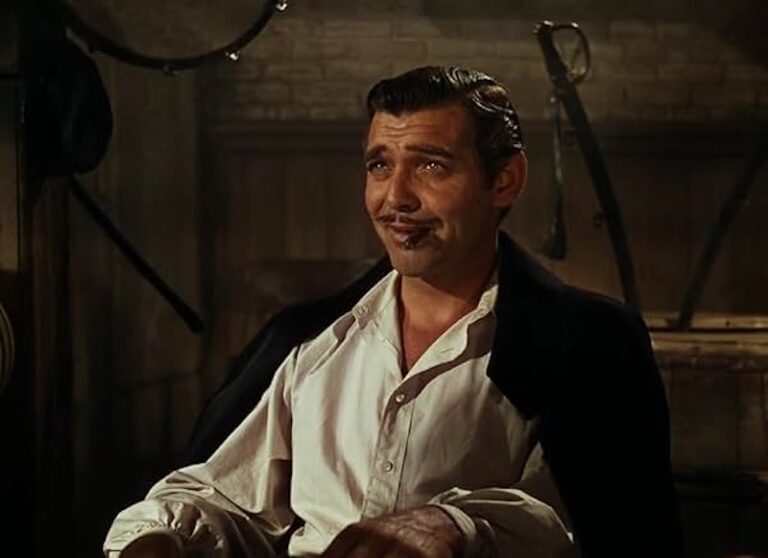
At 238 minutes, GWTW is a narrative of truly epic proportions. Every scene is larger than life, begging the audience to become part of Scarlett’s experience, rather than just watching it. The opening picnic at Twelve Oaks, the lavish balls, the crane shot of War victims sprawled for miles, the burning of Atlanta; nearly ninety years later, the scope of the production is nothing short of amazing. Then of course there are the actors: Vivien Leigh is excellent here; from her first moment on screen, grinning like the Cheshire cat, and sing-song “fiddle-dee-dee,” the British born actress seems to embody Scarlett’s various phases. She effortlessly moves from egotistical teenager to free-spirit and finally, an independent woman. This was Leigh at her best, and despite the big-name actresses that wanted the role, it’s hard to imagine anyone else as Scarlett O’Hara. Clark Gable’s Rhett Butler is among the screen’s most-enduring characters. Gable just seemed to look, act and sneer like the perfect film rogue, and how often have you heard Rhett Butler’s oft quoted line, “Frankly, my dear, I don’t give a damn,” stated as convincingly as he did it?
Some of the other casting isn’t as strong. The biggest issue is probably Leslie Howard as Ashley Wilkes. Howard was a fine actor; however, the character is written as such a weak, unsure, stuffed shirt, that his moments on screen are dwarfed by Leigh and Gable’s powerful personalities. Olivia de Havilland’s shy Melanie is lovely, but she too sometimes gets lost in the shuffle. Not to be forgotten, there is Hattie McDaniel’s strong-willed nursemaid, Mammy, a role that landed McDaniel an Academy Award, making her the first African-American to do so; and there is Thomas Mitchell’s convincing Pa, Gerald O’Hara, and Butterfly McQueen’s endearing but harebrained house servant, Prissy.
There is no denying that GWTW is a largely sentimental view of the Civil War, not so much as a battle between North and South, but as a setup for Scarlett to get her just desserts, and finally, grow up. Yes, the film avoids any discussion of the fact that the gentility of the plantation was purchased with the labor of the slaves. Surprisingly though, Hattie McDaniel and Butterfly McQueen are afforded a higher degree of humility then most African American actors were given in the 1930’s.
It’s important to remember that when GWTW was made, segregation was still law in the American South, and an everyday reality in the North. The Klu Klux Klan was written out of one scene, for fear of offending elected officials of the organization. For those and many other reasons, GWTW will always be a controversial film, but in the end, the thing that makes David O’ Selznick’s production so memorable, is the fact that he provided audiences with a lavish story and told it unbelievably well.
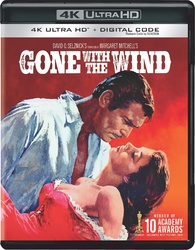
Presented in its original 1.37:1 aspect ratio with Dolby Vision, HDR10, GWTW looks exceptional in 4K. The addition of HDR makes the technicolor photography bolder, and blacks inkier than ever. The image is gorgeously saturated, highlighting breathtaking hues throughout. Vivien Leigh’s eyes sparkle and shine with depth and luster. Depth of field allows for an astounding level of detail, while a nice level of grain gives things a filmic look. The image is clean, with no scratches or blemishes in evidence.
The DTS-HD Master Audio 5.1 track offers conservative surround activity but nonetheless reproduces the source material very well. Dialogue is almost inescapably in the front center channel. Surround channels kick in where you’d expect them to, in such bombastic segments as the Civil War battles. Steiner’s score typically also fills all the channels. This mix preserves the front and center soundfield of the original soundtrack while gently nudging it into the surround channels at appropriate times, resulting in a pleasant listening experience.
English SDH, French, and Spanish subtitles are included.
The extras are a mix of old and new features:
- NEW!! Gone with the Wind: The Influence that Endures: Film critics and scholars alike, discuss the ongoing legacy of Gone with the Wind.
- NEW!! Gone with the Wind: Restoring and Preserving an Epic: An inside look at the restoration of Gone with the Wind.
- NEW!! Scarlett O’Hara: A Woman Ahead of her Time: A look at Vivien Leigh’s portrayal of Scarlett O’Hara.
- Audio Commentary by Film Historian Rudy Behlmer: Behlmer is an expert on all things Gone with the Wind, and provides what has to be one of the best commentaries ever recorded for a classic film. He discusses everything from the casting to the script, and even sheds light on the differences between the film and Margaret Mitchell’s novel.
- The Making of a Legend: The Restoration of Gone with the Wind: Narrated by actor Christopher Plummer, this feature length documentary is filled with information about the history of the property, and its tortuous production, Legend also offers a great assortment of screen tests and other archival film footage.
- Gone with the Wind: The Legend Lives On: A kind of sequel to the above feature, focusing on the legacy of the film. Emphasis on film preservation and some of the collectors of Wind memorabilia is included.
- MGM: When the Lion Roars (Documentary Excerpt): An examination of MGM’s rise to Hollywood powerhouse.
- The 1939 Atlanta Premiere: Some rough footage from the Atlanta premiere, much of which was cut into various newsreels of the era.
- Prologue from the 1939 Atlanta Premiere: Another expository piece which acted as prelude to the foreign release of the film, offering some background on the Civil War.
- Foreign Language Dub Clip
- Historical Document Newsreel Footage
- Theatrical Trailers


