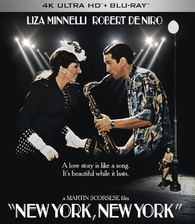
In 1977, director Martin Scorsese was on a roll. Hot off the critical and commercial success of Mean Streets, Alice Doesn’t Live Here Anymore, and Taxi Driver, he was given free rein to do whatever he wished. His pet project was very complex: a blending of cinema verité and the elaborate musical sequences of the 1940’s. Scorsese felt confident enough in his ideas that he began shooting New York, New York without a finished screenplay. In hindsight, that probably wasn’t a good idea.
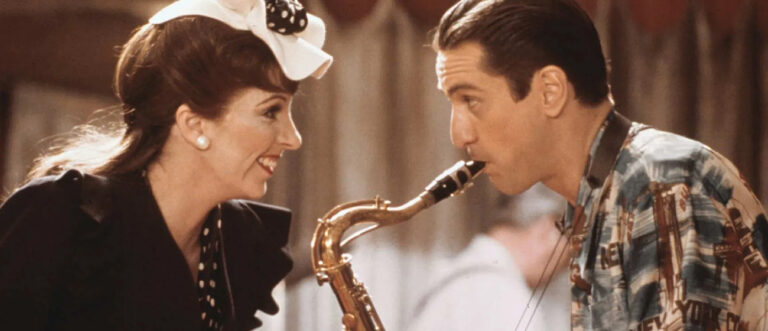
In New York City on VJ Day in August 1945, Jimmy Doyle (Robert De Niro), a selfish and smooth-talking saxophone player, meets singer Francine Evans (Liza Minnelli). Though she initially wants nothing to do with him, Jimmy’s relentless harassment tinged with seduction eventually wins her over. A talented musician, Jimmy has some ideas regarding jazz music that seem hopelessly out of pace in a decade dominated by big bands. Jimmy is immature and quick to fly off the handle, while Francine is a sweet girl, blessed with a big voice. Despite every indication that Jimmy is a complete nut, the two fall in love and marry. Francine helps Jimmy land a steady gig with a traveling big band. However, Francine’s rising star sparks tensions between the two, especially when Jimmy’s career prospects are limited.
The two fight and make up. They fight some more. Francine gets pregnant, and Jimmy gets going. And so it goes, for more than two and a half hours.
Scorsese succeeds in creating the look and feel of the old MGM musicals, but his desire to contrast 70’s realism with the stylized artificiality of the 1940’s doesn’t gel. The fatal flaw is creating such a glitzy spectacle and failing to develop characters that we can care about. I mean what were Scorsese and the writers thinking when they dreamed up Jimmy Doyle? Did they really think audiences were going to embrace this guy who acts like a cross between Travis Bickle and Jake LaMatta? He’s so cruel and obnoxious; I wanted him to disappear a half hour into the film. Jimmy’s lack of any redeeming qualities makes watching his scenes increasingly difficult. However, Francine’s passive reaction to all the abuse hurled her way, that’s even more disturbing. She allows herself to be a doormat, which given the length of the film, means we stop having sympathy for her early on.
According to Liza Minnelli in her recent autobiography, Kids, Wait Till You Hear This, Scorsese and she were having a less-than-clandestine affair, fueled by cocaine. In Andy Warhol’s Diary, the artist recalled that Minnelli, with Scorsese in tow, showed up on Halston’s doorstep one evening begging for “every drug you’ve got.” Scorsese and his then-wife, writer Julie Cameron, divorced shortly after the completion of the film, and the birth of the couple’s child.
Thankfully, Scorsese, De Niro, and Minnelli would all rebound from the disappointment of New York, New York, and entertain us in the decades to come. It’s just a shame they didn’t produce a better film all those years ago.
A sidenote: in 1980, Frank Sinatra would record the film’s title song (originally sung by Liza Minnelli, who does a fabulous job), which would become his biggest hit, and New York City’s unofficial anthem.
A 2025 4K scan and restoration of the original camera negative, the transfer looks great. HDR brings out the lush look of László Kovács cinematography. The stylized 1940’s sets are standout, effectively capturing the era. Fine details are impressive, even in some of the darker scenes. Colors are vivid, particularly red, blue, and orange tones. Grain appears a bit heavy throughout, though it doesn’t negatively affect the overall viewing experience.
New York, New York offers both DTS-HD Master Audio 5.1 and LPCM 2.0 audio tracks. Like the film, the sound design was meant to evoke the feel of the 1940’s. the 5.1 track delivers more than acceptable fidelity, but the spread is across the front channels with very little drifting toward the rears either in terms of music or ambient sound. Dialogue is clean, clear, and concise.
English SDH subtitles are included.
The following extras are available:
4K Disc (Expanded Cut 2:43:10)
- Introduction by Martin Scorsese (UHD, 5:37) The director outlines how he wanted to explore the tension between old-Hollywood artifice and new-Hollywood naturalism.
- Audio Commentary with Director Martin Scorsese and Film Critic Carrie Rickey: The director’s encyclopedic knowledge of cinema always makes for an informative and entertaining time. Rickey’s remarks add some interesting insight.
Blu-ray Disc:
- New York, New York International Version (HD, 2:17:16) features DTS (not DTS-HD Master Audio) 5.1 audio.
- The New York, New York Stories: Part One (SD, 25:31) and Two (SD, 26:58) Broken into two parts, the mini-doc features interviews with Scorsese, producers Irwin Winkler and Robert Chartoff, screenwriter Mardik Martin, director of photography Laszlo Kovacs, Editor Tom Rolf and others. Winkler is blunt in his assessment of New York, New York: “It doesn’t quite work, frankly.”
- Liza on New York, New York (SD, 22:09) Minnelli discusses her life as the child of two famous parents, her career, and experiences making New York, New York.
- Alternate Takes / Deleted Scenes (SD, 19:14) Reveals the extent of improvisation that Scorsese and the actors employed, but this stuff was excised for a reason.
- Audio Commentary on Selected Scenes by László Kovács, ASC (SD, 10:14) The veteran cinematographer describes the headaches that stemmed from coordinating Scorsese’s often complicated visions.
- Photo Gallery (HD, 2:33)
- Theatrical Teaser (HD, 2:07)
- Theatrical Trailer (HD, 3:26)
- Reversible Sleeve