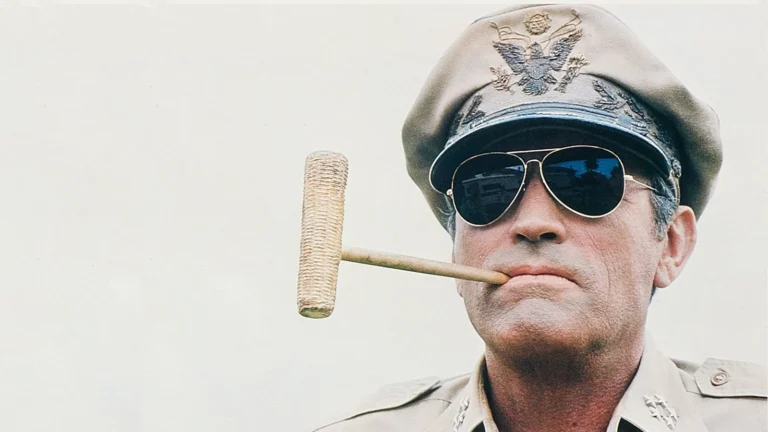
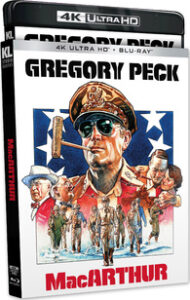
Given the success of Patton in 1970, it earned ten Oscar nominations, winning Best Actor for George C. Scott, Best Picture, Best Director, and Best Screenplay, a biopic of fellow World War II General Douglas MacArthur seemed inevitable. Released in 1977, MacArthur stars as the eponymous General.
During his farewell address to West Point, General Douglas MacArthur looks back on his storied military career filled with both triumphs and tragedies. Starting in 1942, with his famous declaration, “I shall return,” at the beginning of the Battle of Bataan, and continuing through his troop’s successes in the South Pacific, to his 1951 firing by President Truman during the Korean War. Along the way, MacArthur makes several daring tactical decisions confirming his extraordinary abilities as a strategic commander, while putting his unapologetic ego on display.
Still a controversial figure more than sixty years after his death, MacArthur’s defenders call him one of the greatest military commanders in United States history, while his detractors see him as a power-hungry war monger. MacArthur screenwriters Hal Barwood and Matthew Robbins paint MacArthur as neither a saint nor a monster, but as an intense military lifer with a rigorous sense of patriotism.
One of the great actors of the 20th century, Gregory Peck commands the screen as only he can. He effectively captures both MacArthur’s arrogance and intensity, elevating a script that does nothing more than hit on the well-known highlights of MacArthur’s career, in a dry, scene-to-scene manner. Unfortunately, supporting characters, even presidents Roosevelt and Truman (played by Dan O’Herlihy and Ed Flanders, respectively), fade into the background.
Peck expressed dissatisfaction with the script and the decision to film much of MacArthur on the back lot of universal. Budgetary shortcuts are obvious, with the use of stock footage in several scenes. The visual quality plummets, with the shots looking years older than the original negative. Overall, MacArthur has a “made-for-television” look that dwarfs MacArthur and his accomplishments.
The direction by Joseph Sargeant is yeoman-like, if a bit flat. Compared to Patton, MacArthur lacks the insightful exploration of the central character that makes the earlier film so well regarded. Nonetheless, Gregory Peck’s performance makes MacArthur worth watching despite its shortcomings.
Presented in the 1.85:1 aspect ratio, Kino Lorber’s 4K release is from a brand HDR/Dolby Vision transfer created from a 4K scan of the original 35mm camera negative, delivers solid results. The earthy, somewhat diffused appearance, offers a clearer image than Universal’s previous Blu-ray release. The decidedly dull color palette—leaning heavily into browns—looks authentic with a nice level of contrast. Blacks are inky throughout. and a nice degree of grain gives the proceedings a nice, filmic appearance. Devoid of any scratches or other anomalies, this is easily the best MacArthur has ever looked on disc.
The 5.1 surround sound audio track offers a nice separation from the rare channels. This is particularly apparent during battle sequences, which also offer a real sense of depth throughout. The score by the legendary Jerry Goldsmith offers both subtlety and intense swells when appropriate. There are no pops, or other anomalies.
English SDH subtitles are included.
The following extras are available:
DISC 1 (4KUHD):
- Audio Commentary by Filmmaker/Historian Steve Mitchell and Combat Films: American Realism Author Steven Jay Rubin
DISC 2 (BLU-RAY):
- Audio Commentary by Filmmaker/Historian Steve Mitchell and Combat Films: American Realism Author Steven Jay Rubin
- Radio Spots
- Theatrical Trailer