[amazon_link asins=’B076F3Y3H3′ template=’ProductAd’ store=’moviegazett03-20′ marketplace=’US’ link_id=’99e02af7-40c5-11e8-91a2-87b25fc2bdea’]In an era when sex and booze fueled antics were the focus of most films aimed at teens, Hughes was responsible for the of Sixteen Candles, Pretty in Pink, Some Kind of Wonderful, Ferris Bueller’s Day Off, and The Breakfast Club. In all of them, he shows a respect for the characters being portrayed and the young members of his audience. Often credited with defining teen culture of the time, in 2016, The Breakfast Club was selected for preservation in the United States National Film Registry by the Library of Congress as being “culturally, historically, or aesthetically significant.”
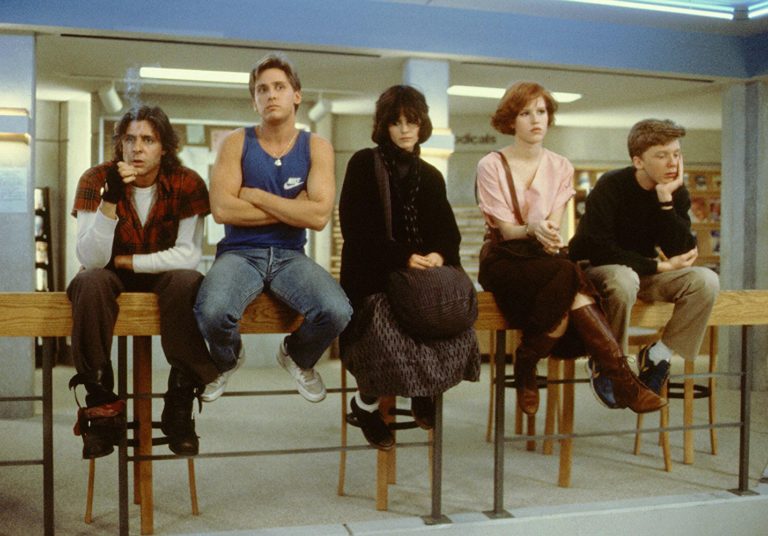
Shot in sequence at an abandoned high school, the concept of the film is simple–five students must spend all day Saturday in detention–but the narrative structure is what makes things particularly interesting. All very different people, Hughes created characters that fit traditional stereotypes, and then peeled back the layers. Andrew Clark (Emilio Estevez) is the school jock with a great future as long as he does what he’s told. Claire Standish (Molly Ringwald) is the popular girl, the one who everyone thinks is perfect, the youngest, Brian Johnson (Anthony Michael Hall) is the harmless brain, Allison Reynolds (Ally Sheedy), is the outcast with nothing to say to say, and John Bender (Judd Nelson) is the bad boy.
Confined to the library, the group slowly begins to open up. It turns out none of them communicate well with their parents and they feel tremendous peer pressure to fit in. As obvious as those observations are, few films had dealt with those issues as honestly as The Breakfast Club. While teenagers today might find the film a bit slow given the absence of cell phones and other technology, the struggle to fit in and be part of a group, still resonates.
While Hughes shows respect for his adolescent characters, he’s not afraid to portray adults as idiots. Here, Assistant Principal Vernon (Paul Gleason), assigned to supervise detention, revels in his power, such as it is. More subtlety, the students dread the possibility that they might become just like their parents.
Hughes managed to assemble the perfect cast for The Breakfast Club. Despite being 22 at the time of filming, Emilio Estevez (St. Elmo’s Fire) effectively shows the human side of an athlete on a pedestal. Judd Nelson, also a little bit on the old side (age 24), is believable as a troubled soul looking for acceptance. Molly Ringwald, the star of three Hughes films (the other two being Sixteen Candles and Pretty in Pink), gives the strongest performance by showing the ugly, shallow side of being Ms. Popular. Ally Sheedy is wonderfully weird as a compulsive liar and thief who takes a long time to open up. Anthony Michael Hall is fine as Brian, but perhaps unfairly, it seems like he was just playing another version of the geek from Sixteen Candles.
More than thirty years after its theatrical debut, The Breakfast Club endures because of its characters, accuracy, and candor. Even after all these years, Hughes’ insightful observations remain grounded and delivered with respect.
This 4K restoration from the original 35mm camera negative is a thing of beauty. There’s an amazing amount of depth, with solid grain levels and texturing on clothing and objects. The color palette is vibrant throughout and blacks are inky. Contrast is spot on and there are no digital anomalies to report. Fans should be very pleased with this transfer.
The audio, presented with both the original English 1.0 LPCM soundtrack and an alternate English 5.1 DTS-HD track with optional subtitles in English SDH, is also impressive. The mono track is the winner of the two for me, but the 5.1 is not without its positive points. There’s not a lot of separation, but there are some moments where the surrounds kick in, especially as relates to the music. Dialogue is clean and clear on both tracks. It’s nice to have the option.
The following extras are available:
- Audio Commentary: Recorded in 2015, this features actors Anthony Michael Hall and Judd Nelson and is moderated by producer Jason Hillhouse. It’s a congenial chat, but nothing groundbreaking.
- Sincerely Yours (HD, 51:01) A documentary featuring interviews with actors John Kapelos, Ally Sheedy, Judd Nelson, and Anthony Michael Hall; costume designer Marilyn Vance; filmmakers Amy Heckerling and Michael Lehmann; writer Diablo Cody; and journalist Hank Stuever.
- Deleted and Extended Scenes (HD, 50:00) A large group of scenes cut from the 150-minute rough cut of The Breakfast Club. The content was sourced from analog masters.
- Molly Ringwald & Ally Sheedy Interview (HD, 19:38) Recorded exclusively for Criterion in 2017, the actresses explain how they got into the film business, discuss their first meeting with John Hughes, how they were chosen to play their characters and more.
- Rare Promotional Archival Interviews and Footage (HD, 37:49)
- Judd Nelson Interview: Recorded on the set of The Breakfast Club, Nelson explains how he came to be involved with the film, and what working with John Hughes is like.
- Ally Sheedy Interview: Also conducted on the set, Sheedy discusses how she came to be involved with the film, working with Hughes, the strength of the script and more.
- Irene Brafstein Interview: Also conducted on the set, the studio teacher discusses her work getting the young actors ready to appear in the film.
- Paul Gleason Interview: Also conducted on the set, Gleason discusses how he became involved in the film, working with the younger actors and their approach to the material.
- American Film Institute, 1985 John Hughes (HD, 47:21) Hughes covers a range of topics, including his evolution in the business from writer to director, the numerous changes he made to The Breakfast Club script, the relationships between the five main characters and more.
- 1999 Radio Interview with John Hughes – Sound Opinions (16:06) Conducted by Jim DeRogatis of The Chicago Sun Times and Greg Kot of The Chicago Tribune, Hughes offers insight into the soundtrack/sound design for the film.
- Electronic Press Kit (HD, 23:49) The videotape isn’t in the greatest condition, but it’s interesting to see how promotion worked circa 1985. The collection is broken down into seven sections: “Ensemble Profile”, “John Hughes Profile”, “Dede Allen Profile” (about the film’s famous editor), “Youth Picture”, “Roller Coaster”, a short featurette and then the films theatrical trailer.
- Today (SD, 9:42) A segment from a 1985 episode of Today featuring interviews with actors Molly Ringwald, Judd Nelson, Anthony Michael Hall, Emilio Estevez, and Ally Sheedy. The interviews were conducted by Jane Pauley.
- Describe the Ruckus (HD, 12:13) Created exclusively for Criterion in 2017, this video essay features Judd Nelson reading John Hughes’ production notes for the film.
- This American Life (16:13) On the radio program This American Life, Molly Ringwald discusses what it’s like to watch The Breakfast Club as a parent. The episode was originally broadcast in 2014.
- Booklet: 22-page illustrated booklet featuring David Kamp’s essay “Smells Like Teen Realness” and technical credits.