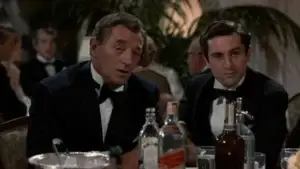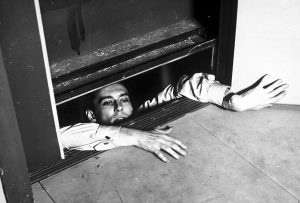
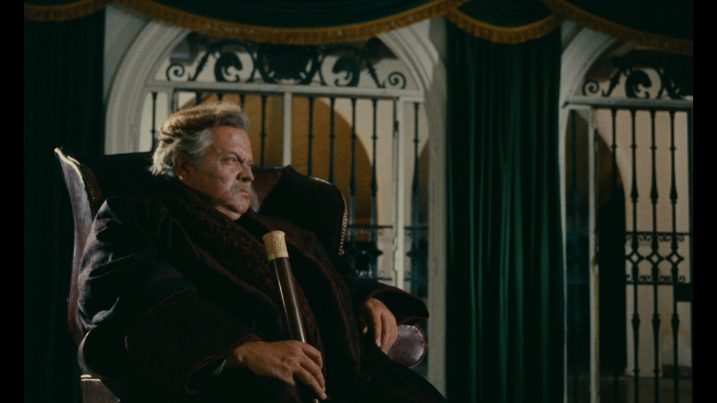


Elishama Levinsky is sent off to find both a sailor and a beautiful young woman willing to play he parts. Levinsky approaches the daughter of a business partner Clay drove to suicide. Strikingly beautiful, Virginie Ducrot (Jeanne Moreau), sees the offer as a way to get revenge. Everything is put into place when a Danish sailor named Paul (Norman Eshley) to do the deed. From there, things take a rather unexpected turn.
It should come as no surprise that the performances here are strong across the board. Welles, with his instantly recognizable voice and powerful presence, nearly dominates every scene he’s in. Roger Coggio as Elishama Levinsky is interesting. Loyal servant, there are snippets of dialogue that make you think the relationship goes much deeper, but it’s never explicitly stated or explained. Jeanne Moreau is simply stunning. Her eyes are piercing and just draw you in. Cinematographer Willy Kurant captures her in a few shots where she looks almost angelic. Norman Eshley has a tendency as a bungler, which plays in to later events.
Scripted by Louise de Vilmorin and Orson Welles, The Immortal Story doesn’t stray too far from its literary origins and its never particularly exciting. The concept feels a bit half baked, but the average material is elevated by impressive performances by all involved.
Presented in the 1.66:1 aspect ratio, Criterion has provided a strong 1080p presentation. Both the English, and the French versions (roughly seven minutes shorter), are included here. They are equally impressive, with a filmic, grainy texture and an appropriate color palette. Contrast is also well balanced and the cinematography shines. There are no image issues to report.
Both the English and French versions of the film are given a PCM mono track. The film contains no real effects, but it does have some nice music by Erik Satie—Gymnopedie No. 1 and No. 3. —The dialogue is clean and clear throughout.
English SDH, English (on French-language version of film) are included.
The following extras are available:
- Audio Commentary from 2005 Featuring Film Scholar Adrian Martin: On the English language version of the film, Martin discusses the difficulties of filming in France and Spain, the often difficult demeanor of Orson Welles, the themes explored in The Immortal Story, etc.
- Portrait: Orson Welles (HD, 42:53) A 1968 documentary directed by François Reichenbach and Frédéric Rossif, this was shot just after The Immortal Story finished filming. The documentary contains quite a bit of interview footage of Welles, who seems rather happy, and provides some interesting insights into his career.
- New interview with actor Norman Eshley (HD, 14:17) the actor who played Paul the sailor in the film discusses his role, and his experience as a young actor working with a legend like Orson Welles.
- Interview from 2004 with Cinematographer Willy Kurant (HD,15:00) Kurant discusses his first meeting with Welles to talk about the film just after Welles had gotten rid of the first cinematographer, his decisions regarding lighting, etc.
- New Interview with Welles scholar François Thomas (HD, 25:14) Thomas discusses the films production, the budget, location, Welles’ working style, etc.
- Booklet: Illustrated booklet featuring an essay by Jonathan Rosenbaum.
[rwp-review id=”0″]