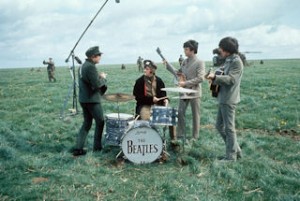
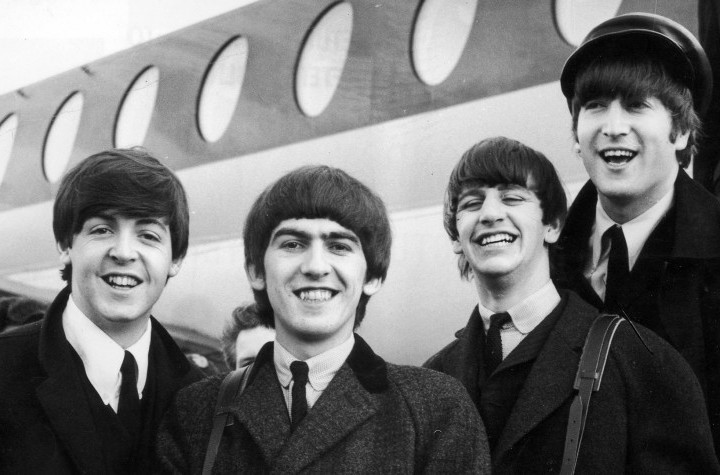


It’s clear from the start that A Hard Day’s Night is different from the rock musicals of the time that starred Elvis Presley. There’s a frenetic energy and realism that Elvis’ people would have never sanctioned. It’s irreverent and doesn’t take itself too seriously. Conceived just before “Beatlemania” officially began, A Hard Day’s Night made it clear that the The Fab Four wanted to separate themselves from the “angry young man” pictures featuring the likes of Richard Burton, Tom Courtenay, Richard Harris, and others that centered on the grimier side of British life that were popular at the time.
The American-born director Richard Lester likely had a lot to do with the drastic departure from what was fashionable at the time. Having moved to London in the fifties, he produced and directed several shows on British television, including The Goon Show featuring the likes of Peter Sellers, Spike Milligan, and Harry Secombe. Lester was clearly comfortable directing The Beatles, and wasn’t afraid to combine their musical talents with a version of the comedy he had previously directed. Sheer silliness combined with a sharp wit was clearly his aim.
Lester went with a documentary style feel. Though the film was scripted, screenwriter Alun Owen (largely known for his work on British television) wrote a decidedly simplistic narrative that allowed for a lot of improvisation. Things begin in Liverpool, where where George, John, Paul, and Ringo board a train together with their manager Norm (Norman Rossington) and Paul’s grandfather (Wifred Brambell). They’re headed to London where the Beatles are scheduled to perform live on a popular TV show. The boys try to relax during the ride, but find themselves frequently bothered by conceited adults, and distracted by beautiful girls.
Arriving in London, the boys are constantly on the move—talking to reporters, telivison producers, and trying to avoid hordes of raucous young girls. Just hours before the band is to perform; Ringo disguises himself with a trench coat and disappears. The show’s producer (Victor Spinetti) goes into full on panic mode, and everyone fans out in a desperate search for the missing drummer.
Though the film is scripted, much of it feels like it could have been a typically day in The Beatles lives around 1964-65. It’s almost as if, with Alun Owen’s script providing a prompt when necessary, Richard Lester simply turned the camera on John, Paul, George, and Ringo and let it run most of the time. Lester’s genius comes in his framing and shot selection, which made it seem as though The Beatles didn’t realize the camera was even there. Props should also go to editor John Jympson (Zulu, Frenzy, A Fish Called Wanda) who managed to put everything together in a smoothly flowing manner. There are no sudden cuts, one event flows perfectly to the next.
As one would expect, the music is magnificent. There are fabulous performances of such classics as “A Hard Day’s Night”, “Tell Me Why”, “If I Fell”, “And I Love Her”, “Can’t Buy Me Love”, and “I Should Have Known Better”. For any fan of The Beatles, hearing these songs is a true highlight of the film.
Released in London on July 6, 1964, A Hard Day’s Night was a major box office success. The film became so popular, that at one point there were more than 1,600 prints were in circulation simultaneously. By 1971, the film had estimated earnings of a then staggering $11 million worldwide. A Hard Day’s Night was also nominated for two Academy Awards: for Best Screenplay (Alun Owen), and Best Score (Adaptation) (George Martin)
Presented in the 1.75:1 aspect ratio, Criterion’s 1080p transfer is fabulous. A new 4K digital restoration approved by director Richard Lester, the level of detail is superb. The image is crisp, and contrast is stable. Grain is well refined and evenly distributed. There doesn’t appear to be any sharpening tools in use. Any debris, damage marks, etc. have all been carefully removed. This is truly a beautiful black-and-white presentation from start to finish.
There are three standard audio tracks on this Blu-ray release: English LPCM 2.0 (mono), English LPCM 2.0 (stereo), and English DTS-HD Master Audio 5.1. I viewed the entire film with the lossless mono track and found it to be quite impressive. It possesses excellent depth and clarity. Range is solid, and surprisingly nuanced. The dialogue is clean, clear, and consistent throughout. Songs are clear, if not particularly dynamic.
Testing selected scenes with the new 5.1 track made by Apple Records, improved dynamics are obvious (songs sound fuller, and have a bit more bass) and a generally more open feel.
English SDH subtitles are included.
The following extras are available:
- Audio Commentary: Created from material produced by Martin Lewis in 2002, it features actors John Junkin, David Janson, and Jeremy Lloyd; cinematographer Gilbert Taylor; associate producer Denis O’Dell; second assistant director Barrie Melrose; assistant editors Pamela Tomling and Roy Benson; and others. There’s a lot of people to follow here, but together they do give you a sense of what things were like during the making of A Hard Day’s Night.
- In Their Own Voices (HD, 18:02) Behind-the-scenes footage of A Hard Day’s Night, along with audio clips from interviews with members of The Beatles in which they discuss making their first film. The interviews were conducted during the British band’s 1964 American tour.
- You Can’t Do That: The Making of A Hard Day’s Night(HD, 102:10) Narrated by singer/musician Phil Collins, and produced by Walter Shenson (producer of A Hard Day’s Night) this 1994 documentary features clips from archival interviews with Roger Ebert, Peter Noone (lead singer of Herman’s Hermits), Roger McGuinn (founding member of The Byrds), cast member Victor Spinetti, wardrobe designer Julie Harris, screenwriter and Alun Owen, among others. An outtake performance is also included.
- Things They Said Today (HD, 36:17) Produced by Martin Lewis in 2002, this documentary examines the production history and success of A Hard Day’s Night. Included are interview clips with David Picker (VP Production & Marketing, United Artists Corporation/1962 to 1964, Sir George Martin (The Beatles’ record producer), Tony Barrow (Beatles publicist/1962-1966), producer Walter Shenson, and director Richard Lester, among others.
- Picturewise (HD, 27:13) Recorded exclusively for Criterion in 2014, this video essay looks at Richard Lester’s directing style, some of his early work, and his handling of A Hard Day’s Night. Written and produced by critic and filmmaker David Cairns, a new audio interview with Richard Lester is also included.
- The Running Jumping & Standing Still Film (HD, 11:11) Shot by Richard Lester on a shoestring budget in 1959, it was nominated for an Oscar for Best Short Subject, Live Action Subjects. It features Richard Lester, Peter Sellers, Spike Milligan, Graham Stark, and Bruce Lacey. B&W. Music only.
- The Beatles: The Road to A Hard Day’s Night (HD, 27:14) In this interview conducted exclusively for Criterion in 2014, Mark Lewisohn, author of The Beatles: All These Years, Volume 1 — Tune In, discusses The Beatles career and their tremendous impact on the music industry.
- Anatomy of a Style (HD, 17:07) Story editor and screenwriter Bobbie O’Steen and music editor Suzana Peric discuss the atypical editing and framing of the music sequences in A Hard Day’s Night.
- 2000 Re-release Trailer (HD, 2:00)
- 2014 Re-release Trailer (HD, 1:39)
- Booklet: An illustrated booklet featuring an essay by critic Howard Hampton and excerpts from a 1970 interview with Richard Lester.
- DVDs: Two DVD’s containing the film, and all the extras featured on the Blu-ray.