

Recent college graduates Alice Kinnon (Chloë Sevigny) and Charlotte Pingress (Kate Beckinsale) are assistant editors at a Manhattan publishing house, able to live in the city on their low wages thanks to the continuing support of their fathers. The rest of the group includes Des McGrath (Chris Eigeman), one of the club managers; Jimmy Steinway (Mackenzie Astin), a friend of Des’s who “works in advertising” and as such is banned from the club, though his job depends on getting people in; Holly (Tara Subkoff), a submissive girl pressured into being Alice and Charlotte’s roommate; Dan (Matt Ross), an unapologetic liberal in an otherwise apolitical group, who works at the New York publishing house and eventually begins dating Holly; Tom Platt (Robert Sean Leonard), a casual acquaintance of Alice’s, who is slightly attracted to her; and Josh Neff (Matt Keeslar), who went to college with Des and finds himself pursuing Alice when they meet by chance at the club.
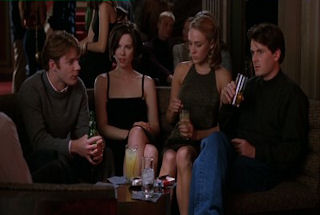 With a group of people this big, naturally a lot of things, some big, most not so much, happen. Stillman’s rather breezy narrative style allows us to observe as these young adults in their 20’s living on their own in the big city, reject the lifestyle their parents expect them to live. Stillman’s characters are far from sympathetic figures. Beckinsale’s Charlotte is a truly horrible human being, who delights in hiding her meanness in backhanded compliments and snarky concern. In a great example of a toxic friendship, Chloë Sevigny’s Alice responds to Charlotte with the perfect mix of fear and hatred. One gets the feeling that as much as she hates Charlotte for treating her the way she does, part of Alice longs to be as aggressive and in-your-face as Charlotte. Theirs is not the kind of female “friendship” we see depicted in the movies very often.
As a club manager, Des would appear to be in an enviable position. However, he’s facing pressure on multiple fronts. A jealous co-worker is trying to oust him and jimmy’s constant attempts to sneak into the club have put his job in danger. Despite his troubles, it’s hard to feel sorry for Des, who breaks up with his most recent conquest(s) by tearfully confessing his recent revelation that he’s gay.
What little plot there is involves the character’s attempts to find love, go to the club as often as possible, money laundering and drugs. Essentially, these young people believe that the end of the disco era was the best time in their lives. We realize that it wasn’t disco that was so special but youth. Even for the most educated among us, it’s sometimes tough to realize it’s time to grow up and face the big, bad, world.
Framed in the 1.78:1 aspect ratio, Criterion’s 1080p transfer is reference quality stuff. Saturation levels and image sharpness are perfect. Flesh tones look normal and contrast has been perfectly balanced throughout. Black levels are solid. No digital anomalies are present.
The DTS-HD Master Audio 5.1 sound mix is very nice, providing a showcase for the stream of disco classics that pepper the soundtrack. Dialogue is well recorded and remains clear and audible throughout. Notably, the surround channels don’t allow as much ambient sound as one might like, but this is still an above average track.
English SDH subtitles are available.
The following special features are included:
- Commentary with Writer/Director Whit Stillman, Chris Eigeman and Chloë Sevigny – Recorded in 2009, this commentary is a fact-filled look back on the film. They talk about racing through production to open before the similar movie 54.
- Deleted Scenes (SD, 8 min.) – These four scenes don’t really add much to the film. One scene shows Des talking about his obsession with the series “Wild Kingdom.” Another reveals a subplot of Des’s diary of life and sexual exploits. Another shows Alice crying on a couch. The fourth is a montage (of sorts) set to “Amazing Grace.”
- From the Novel (HD, 17 min.) – Stillman wrote a companion novel two years after the movie was released that follows one of the many characters two years after the narrative of the film ends. It’s supposed to be the character looking back on the events of the film in retrospect. This feature is audio of 17 minutes from the novel being read by Stillman.
- Featurette (SD, 6 min.) – This EPK is like a promo reel from the film, except it paints “The Last Days of Disco” as a romantic comedy and not as the serious drama that it is.
- Still Gallery – A huge set of production videos with lengthy captions from Stillman explaining each one.
- Trailer(SD, 2 min.)
- Leaflet: featuring David Schickler’s essay “Pop Paradise”. (Mr. Schickler is the author of the novels Kissing in Manhattan and Sweet and Viscous).